Looking for the best travel apps for slow travel? After 12 months across Southeast Asia and Europe, here’s what actually gets used every day. Search “best travel apps” and you’ll get a list of 25–30 tools, most of which you’ll download, open once, and never think about again.
This is not that list.
After 12 months of slow travel across Southeast Asia and Europe — moving through Vietnam, Malaysia, Thailand, Indonesia, Singapore, South Africa, and Portugal — we’ve worked out what actually gets used every day and what just takes up space on your phone. The stack is smaller than you’d think. Here’s what’s on it, why it’s there, and — just as importantly — what didn’t make the cut.
Staying Connected: Airalo
If you’re moving between countries on a long trip, constantly swapping physical SIM cards gets old very quickly. Airalo solved that for us.
An Airalo eSIM installs digitally before you land — which means you step off the plane with data already working, no airport kiosk queue, no hunting for a local provider in an unfamiliar arrivals hall. For our Asia trip we used the regional eSIM across multiple countries without changing anything. It just worked.
Honest note: it’s not always the cheapest option if you’re staying somewhere for weeks. In that case, a local SIM often makes more financial sense. But for arrivals and shorter stays, the convenience is worth the small premium.
Grab an Airalo eSIM here — save 15% on your first eSIM.
Getting Around: Grab and Uber
Between them, Grab and Uber cover almost every transport situation you’ll encounter.
Grab is essential in Southeast Asia — Vietnam, Malaysia, Thailand, Indonesia, Singapore. It’s reliable, the pricing is transparent before you confirm, and it removes the language barrier and negotiation entirely. In Da Nang we used it almost daily. In Kuala Lumpur it was cheaper and faster than any alternative.
Uber handles Europe and most major cities outside Southeast Asia.
Have both installed before you travel. Coverage varies by country and you’ll want the right one ready without having to figure it out on the kerb with luggage.
One consistent piece of advice for both: don’t request the ride until you’re standing outside. In Da Nang, drivers arrived before we’d made it to the street.
Accommodation: Airbnb and IHG
Airbnb remains one of the best tools for longer slow travel stays — weeks or months somewhere. The ability to have a kitchen, a proper workspace, a washer and dryer, and space to actually live rather than just sleep makes a real difference when you’re not moving every few days. We’ve used it extensively across the trip for our longer stays.
Honest reality check: Airbnb prices have increased significantly in recent years. Don’t assume it’s automatically cheaper than a hotel. Always compare — particularly for shorter stays where a well-located hotel can offer better value and fewer variables.
IHG is the other side of our accommodation strategy. The IHG One Rewards app is how we keep track of points, monitor account status, and check properties. We tend to use the desktop for actual bookings, but the app is useful for staying across your rewards in real time — and IHG properties have given us some of the best hotel stays of the whole trip, often redeemed entirely on points.
Money: Wise and Charles Schwab
Wise earns its place on this list through a very specific use case that took us by surprise.
When Marge needed to pay her hairdresser in Malaysia, the hairdresser’s preferred payment method was Wise. It came up again on one other occasion during the trip — a local business that simply operated that way. Wise uses real mid-market exchange rates with transparent fees, which makes it genuinely useful for international transfers and payments. If someone you’re dealing with abroad asks for payment via Wise, you’ll want it set up already.
For day-to-day cash withdrawals, our primary tool is the Charles Schwab Investor Checking debit card, which reimburses all ATM fees worldwide automatically at the end of each month. Across 12 months in multiple countries, that reimbursement has added up to a meaningful amount. If you’re doing any kind of extended international travel, get this card sorted before you leave home.
Your home banking and credit card apps also belong in this category — not for spending, but for security. Enable transaction notifications on everything. The ability to freeze a card instantly from an app, anywhere in the world, is something you hope you never need and will be very glad to have if you do.
Flights, Tours and Activities: Airline Apps and Viator
Download the app for every airline you’re flying. Not as a general principle — as a specific, practical instruction.
Here’s why: TripIt Pro told us about a gate change before it was announced at the airport. The airline app confirmed it. Between the two, we were already moving while other passengers were still waiting for the announcement. That’s not a minor convenience — in a busy airport, that’s the difference between a relaxed connection and a sprint.
Which brings us to TripIt — and we want to give this one more than a passing mention because it genuinely runs our travel life.
Every booking goes into TripIt immediately: flights, accommodation, tours, restaurant reservations, transfer confirmations. It builds a master itinerary automatically and keeps everything in one place accessible offline. At immigration, when an officer asks for your outbound flight details, you open TripIt and show them or read them the information. No hunting through email. No explaining which app the booking is in. It’s all there.
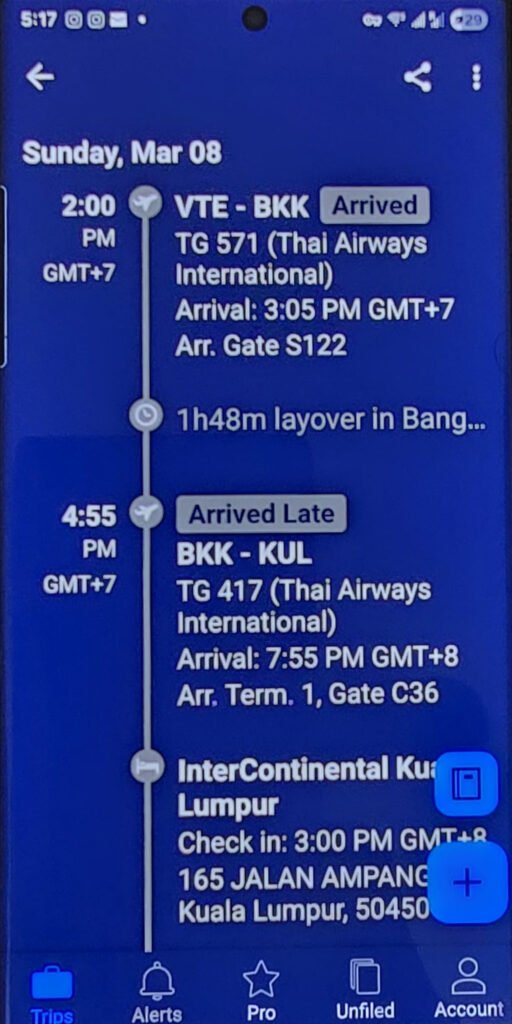
We use TripIt Pro, which adds real-time flight alerts, gate changes, and delay notifications. It has paid for itself many times over. If you’re doing any serious amount of travel, upgrade. You won’t go back.
For tours and experiences, Viator has been our consistent go-to — Joy Elephant Sanctuary in Chiang Mai, Sticky Waterfalls, the Cape of Good Hope day trip from Cape Town, Mount Batur in Bali. Reliable operators, verified reviews, and flexible cancellation policies that matter when travel plans shift. Browse tours for your next destination here.
Communication: WhatsApp
WhatsApp is not a nice-to-have. It is the primary communication tool for most of the world outside North America, and you will use it constantly.
Tour operators confirm bookings through WhatsApp. Airbnb hosts communicate through WhatsApp. Local businesses respond on WhatsApp when they won’t pick up a call from an unfamiliar number. In Vietnam, Thailand, Malaysia, and South Africa, it was the default channel for almost every logistical conversation we had with locals.
It’s also how we stay in contact with our kids and family back home — voice calls, video chats, messages — without any international charges on either end. Free, reliable, and works everywhere with a data connection.
If you don’t have it, download it now. If you do, make sure the people you’ll be coordinating with on your trip have it too.
Navigation & Translation: Google Maps and Translate
Google Maps is one of our most-used apps, full stop. We use it for navigation obviously, but also for finding restaurants — the reviews and photos give you a genuinely reliable read on a place before you commit to the walk or the Grab ride. We also use it to research neighbourhoods ahead of arriving somewhere new, mapping out where things are relative to where we’re staying.
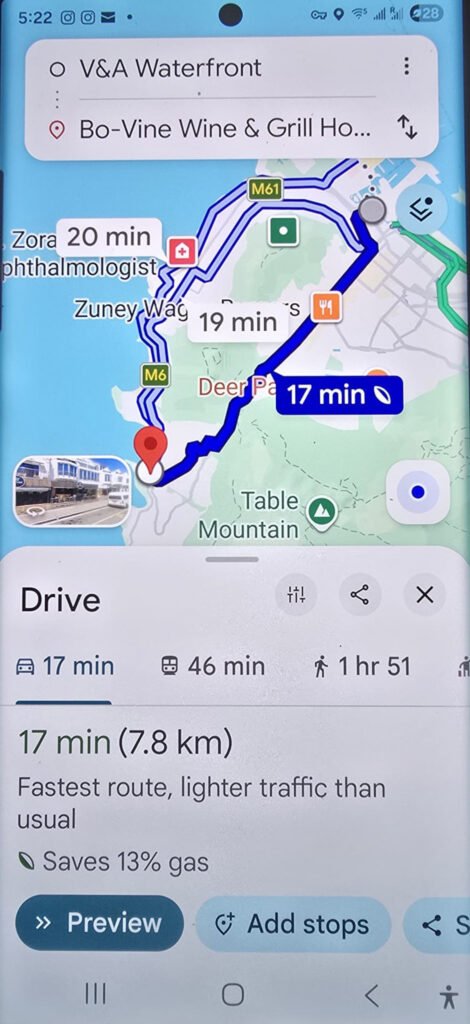
Download offline maps for every country before you travel. Data doesn’t always cooperate at the exact moment you need directions.
Google Translate has saved us more times than we can count, usually at grocery stores and restaurants where the menu or packaging is entirely in the local language. The camera function — point your phone at text and watch it translate in real time — is particularly useful for menus in Vietnam and Thailand. We’ve also used the live conversation feature when communicating with locals who don’t speak English: type or speak, show the screen, and the exchange becomes possible. It’s not perfect, but it bridges the gap consistently enough to matter.
Download the offline language packs for every country on your itinerary before you arrive. Data-dependent translation at a moment when you have no signal is no translation at all.
Security: NordVPN
Public Wi-Fi is everywhere on a long trip — hotel lobbies, airport lounges, cafés, co-working spaces. Not all of it is safe, and the longer you travel, the more you use networks you know nothing about.
We run NordVPN on all our devices — phones, laptops, tablets, and our Amazon Fire Stick for streaming. It protects sensitive data on public networks, keeps banking and financial activity secure, and allows access to content that’s region-locked when you’re outside your home country. It runs in the background without interrupting anything.
This one is less about a specific moment and more about consistent peace of mind across a year of using networks in a dozen countries. At a certain point, not having it feels like a risk not worth taking.
If you’re doing any serious international travel, it’s worth having. Get NordVPN here.
Travel Apps for Slow Travel: How It Looks in a Real Day
On any given day of slow travel, this is what actually gets used:
- Wake up → Check TripIt for the day’s schedule
- Getting somewhere → Google Maps for directions, Grab or Uber for the ride
- Arriving somewhere new → Airalo already running, data working
- Paying locally → Charles Schwab debit card at the ATM, Wise for transfers when needed
- Eating out → Google Maps to find somewhere, Google Translate for the menu
- Communicating → WhatsApp for everything local and home
- Working on hotel or café Wi-Fi → NordVPN running in the background
- Booking something → Viator for experiences, IHG app to check points, Airbnb or desktop for accommodation
That’s the whole stack. No app drawer full of things you opened in 2023 and never touched again. Just the tools that earn their place every day.
The Honest Summary
After 12 months of testing this in real conditions across multiple continents, the conclusion is straightforward: you need fewer apps than you think, and the ones you do need should be set up, loaded, and ready before you land somewhere new.
Get Airalo running before your next departure. Download Google Maps offline. Set up TripIt with every booking the moment you make it. Have WhatsApp ready for every operator and host you’ll deal with. And turn on transaction notifications on every financial account you carry.
Everything else is optional. These aren’t.
🎬 Watch Our Travel Videos
We document slow travel across Asia, Africa, and Europe — the practical reality of it, not just the highlights — on our YouTube channel.
▶️ Find all our travel videos at youtube.com/@milowes43
If you have a travel app you swear by that we haven’t mentioned, drop it in the comments — we’re always open to finding something better.
— Mike & Marge | The Passport Pillow Slow travel for curious souls.