This Da Nang food guide is built on three months of eating — not a weekend visit. On the morning of our first full day in Vietnam, we ventured out for breakfast. We stopped at a local street vendor — Bánh Mì Chao — set up not far from where we were staying in the Son Tra neighbourhood. The lady sold breakfast skillets but we opted for two bánh mìs and two coconut coffees. We sat on little plastic stools in front of the stall and were given Trà đá — Vietnamese iced tea — at no cost alongside the coffees.
That morning began Mike’s love for bánh mì and, more importantly, coconut coffee. He was hooked immediately. The total for two bánh mìs and three coffees — yes, he ordered another one for the road — came to $5.65. That’s Da Nang’s food scene in a single breakfast: exceptional quality, absurd value, and the kind of casual, unhurried experience that makes you want to come back the next morning and do it again.
We did. Many times.
The Food Culture Here
Vietnamese food is often spoken about as a single cuisine, but that’s an oversimplification worth correcting early. Vietnam’s food culture divides meaningfully into three regional traditions — Northern, Central, and Southern — each with its own distinct flavour profile, ingredients, and approach, even when the dish names are the same. A bowl of phở in Hanoi and a bowl of phở in Da Nang are related but not identical.
Da Nang sits in Central Vietnam, which means the food here leans spicier and more complex than the north, and less sweet than the south. The foundations of Vietnamese cooking run deep: rice and rice noodles as the base of almost everything, fresh herbs and vegetables used in volume, fish sauce — nước mắm — as the seasoning that ties it all together, and the unmistakable influence of both Chinese cooking techniques and French colonial ingredients. The bánh mì is the most obvious example of that last point — a Vietnamese sandwich built on a French baguette, filled with ingredients that belong entirely to Southeast Asia.
Street food and restaurant culture both thrive here, across every price range. A street vendor breakfast runs 20,000–25,000 VND — roughly a dollar. A sit-down dinner for two with drinks starts around 380,000 VND and climbs from there depending on where you go. The quality at the lower end of that range is what catches most first-time visitors off guard. It caught us off guard, and we’d been eating across Southeast Asia for months before we arrived.
Markets & Street Food
Da Nang has three markets worth knowing about, each with a distinct character.
Con Market is the most local of the three — a sprawling, busy, working market with a large food section, better prices than Han Market, and the kind of atmosphere that makes you feel like a resident rather than a visitor. Go early for the best produce. This is where the city shops.
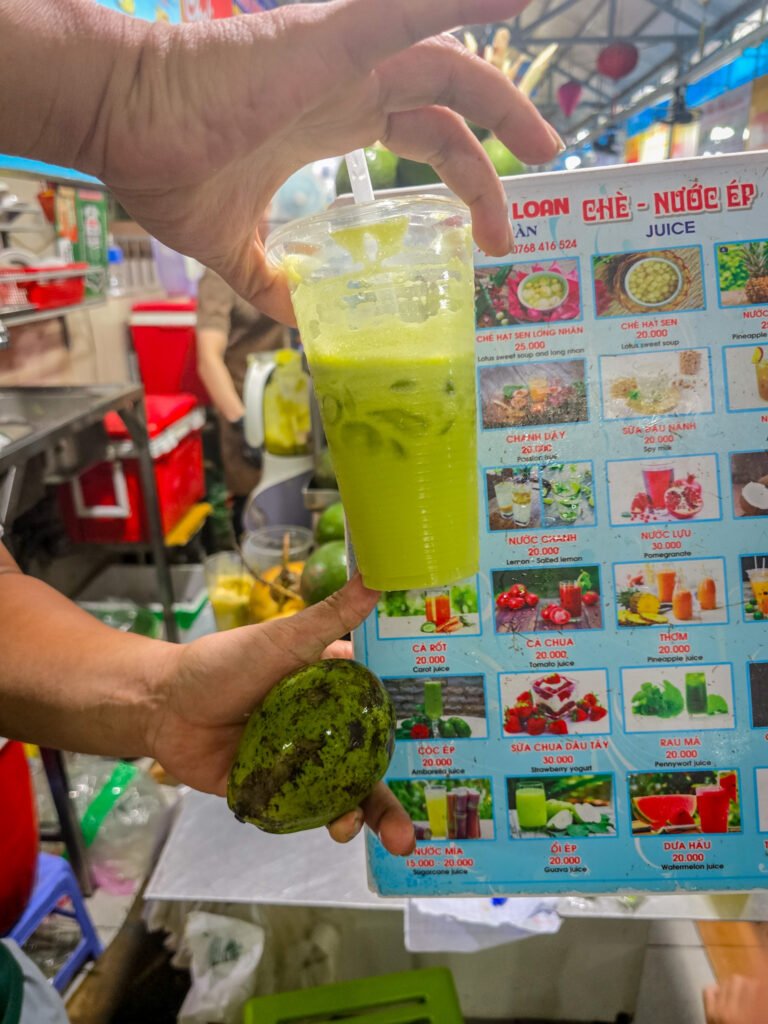
Han Market leans more tourist-facing and doubles as a place to buy clothes and souvenirs alongside its food section. The food hall is large and well-stocked, and it’s where we tried Quả cóc — ambarella in English — for the first time. A small, firm fruit with a tart, tangy flavour that neither of us had encountered before. We enjoyed it enough to go looking for it elsewhere, and found a street stall near our apartment in Son Tra that sold it regularly. We went back often.
Son Tra Night Market is the most overtly touristy of the three, selling primarily cooked food in a lively evening setting. Worth a wander if you’re nearby in the evening, though it’s more atmosphere than culinary discovery.
Practical: Go early to Con and Han markets for the best fruit and vegetables. Cash only at most stalls.
And then there were the bánh bao vendors — motorbike sellers who called through the Son Tra streets morning and evening: “Bánh bao đây! Bánh bao nóng đây!” Fresh steamed buns for 10,000–15,000 VND each. Vietnam’s version of an ice-cream truck. One of those small, daily, unexpected joys that slow travel keeps producing.
Restaurants Worth Naming
Nhà An
Nhà An was our most-visited restaurant across three months — a Vietnamese local food and vegan restaurant close to our apartment in Son Tra that became, genuinely, our place.
Mike’s order never changed: Bò Lúc Lắc — cubed beef quickly seared in a very hot wok with vegetables, served with fries or rice. Marge returned to the beef phở. We went back so many times that the staff became friends rather than servers, and conversations at the table drifted to things that had nothing to do with food. That’s the particular reward of staying somewhere long enough to become a regular. Nhà An earned it.
Cô Ba Phở Bò
On the city side, Cô Ba Phở Bò is a serious restaurant for phở and more — well-executed, consistent, and worth the slightly longer trip from Son Tra. Marge’s meal of choice here was the Mỳ Xào Bò — stir-fried noodles with beef — which is where bok choy appeared and immediately elevated the dish beyond what either of us had expected from it. More on that below.
GUPGO BBQ House
Korean BBQ in a Vietnamese neighbourhood, done properly. GUPGO BBQ House in Son Tra is not a fancy restaurant — it doesn’t need to be. The quality of the meat is genuinely good, and you have the option of cooking yourself at the table grill or having the staff do it for you. What sets it apart from similar spots is what arrives without being asked: complimentary steamed eggs, a kimchi pancake, and Trà đá — Vietnamese iced tea — on the table before you’ve ordered. Very local, very authentic, and the kind of place that rewards being in a neighbourhood long enough to find it.
Xóm Mới Garden
There are restaurants you enjoy and restaurants you remember. Xóm Mới Garden in Hải Châu is firmly the latter.
Tucked away in the middle of the city in a way that makes it feel completely removed from it, Xóm Mới is built around greenery — lush, considered planting that creates a calm, almost garden-like atmosphere that has no right to exist this close to a busy urban district. The interior is beautifully designed and the outdoor dining space is something else entirely: open-air tables set among the plants, shaded and quiet, the kind of setting that makes you want to order slowly and stay longer than you planned.
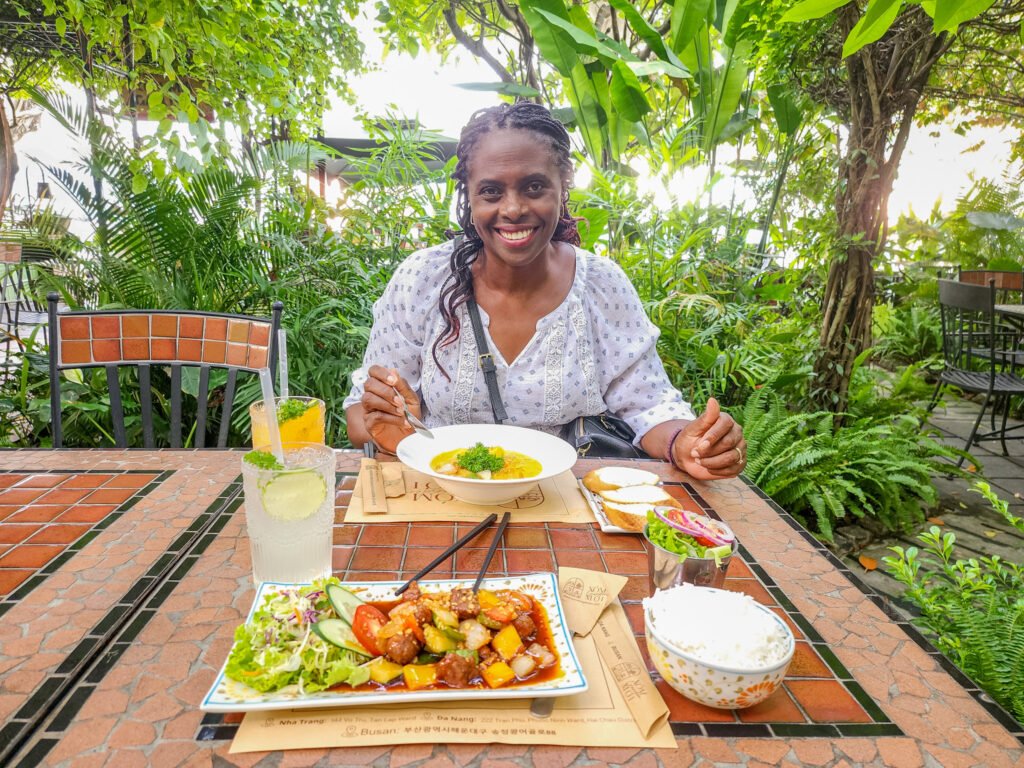
We went twice — once inside, once out on the terrace — and both experiences were worth it in different ways. The outdoor table with Marge’s food arriving in that setting is one of the better food photographs of the whole trip. If you’re in Da Nang and you want one restaurant that delivers on atmosphere as much as the plate, this is it.
Worth Knowing About
Bếp Cuốn Đà Nẵng is well worth a visit — good food, good atmosphere, and the kind of place that gets busy on weekends for good reason. Book ahead if you’re going on a Friday or Saturday evening.
Eco Green Café & Bistro became a regular working café — healthy breakfast sets, reliable Wi-Fi, and very good coconut coffee in a relaxed setting.
Al Fresco’s on Trần Hưng Đạo is a Western menu with genuinely lovely service and a view of the Dragon Bridge that earns its place on an evening out.
Adobo Mexican Grill — yes, Mexican food in Da Nang — delivered a chicken bowl that was better than it had any right to be. Sometimes you just need something familiar, and when that moment arrived, Adobo came through.
The One Meal We Still Talk About
For us it wasn’t one meal — it was one restaurant and one moment of discovery that arrived at different tables.
Mike keeps returning to the Bò Lúc Lắc at Nhà An, and Marge to the Mỳ Xào Bò at Cô Ba Phở Bò. Both for different reasons, both completely genuine.
Marge’s Pick
My pick from Da Nang is the Mỳ Xào Bò at Cô Ba Phở Bò — and I’ll be honest, I didn’t expect it to be.
Stir-fried noodles with beef is a dish I’ve had in various forms across Southeast Asia, and I ordered it without much anticipation. What arrived was something different. The flavours, the textures, the balance of spices — and then the bok choy, which sounds like a small detail but completely changed the dish for me. It was far better than I was expecting, and that gap between expectation and experience is what makes a meal memorable. I’d order it again the moment I walked through the door.
— Marge
Mike’s Pick
Mine is the Bò Lúc Lắc at Nhà An — and not just because of the dish, though the dish is excellent. Cubed beef, seared hard in a wok until the outside catches and the inside stays tender, served with rice and the kind of simple vegetables that let the meat do its work. I ordered it the first time because it was familiar enough to feel safe. I kept ordering it because it was genuinely one of the best things I ate in three months.
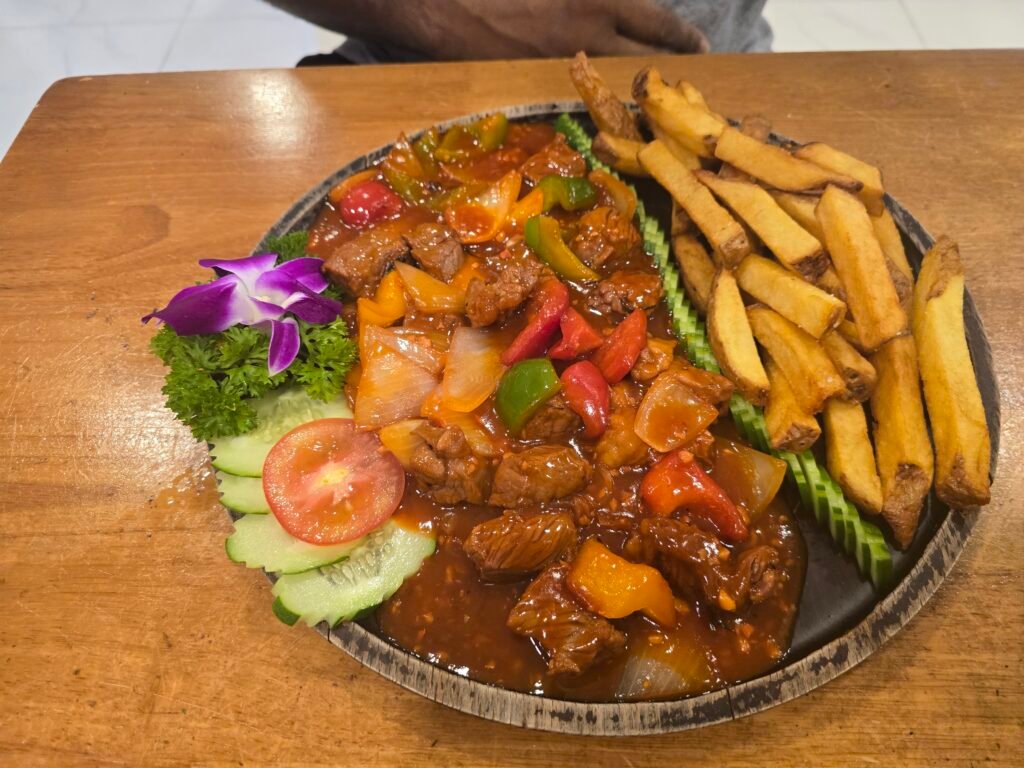
But what made Nhà An the pick wasn’t just the food. It was the staff. By the time we’d been going for a few weeks, conversations at the table had stopped being about the menu. We talked about their lives, they asked about ours, and a restaurant became something closer to a neighbourhood corner. That’s what slow travel makes possible, and Nhà An is where it happened for us in Da Nang.
— Mike
The Coffee — A Category of Its Own
Da Nang’s coffee culture deserves its own mention, separate from the food.
Vietnam is one of the world’s largest coffee producers, and the local coffee tradition — strong, often served over ice, sometimes with condensed milk — is entirely its own thing. But the drink that made the deepest impression was the coconut coffee: cold brew or strong Vietnamese coffee poured over coconut cream and ice, rich and sweet and unlike anything we’d had before.
Our recommendation without hesitation is Út Tịch Café. The coconut coffee is exceptional, the atmosphere is exactly right, and every order arrives with a small dish of complimentary coconut chips. It’s a detail that costs almost nothing and says everything about how this café approaches what it does. We went back more times than we can accurately count.
Practical Notes for Eating in Da Nang
- Price range: A street food meal — bánh mì, breakfast skillet, steamed buns — runs 20,000–25,000 VND (roughly $1). A sit-down restaurant for two with drinks starts around 380,000 VND ($15–18) and rises from there. Korean BBQ at GUPGO runs slightly higher but remains excellent value.
- Tipping: Not a traditional requirement in Vietnam and entirely optional. It’s become more common in tourist areas and always appreciated. We tipped — but that’s a personal call.
- Cash vs. card: Cash is still king at street stalls and markets. Most sit-down restaurants accept cards, but note that many add a 2–3% surcharge for credit card payments — this is common and legal. Factor it in.
- Dietary considerations: Da Nang is easier to navigate than most travellers expect. Vegetarian and vegan options are widely available — multiple dedicated restaurants exist. Gluten-free is increasingly catered for in the café scene. Halal options are more limited than in larger cities.
- Best time to eat: Locals eat early — breakfast vendors are operating from 6am, dinner fills restaurants from around 6:30–7pm. Go early or go late to avoid the peak lunch rush at popular spots. Bếp Cuốn Đà Nẵng specifically — book ahead on weekends.
- Ordering tip: At street stalls, point at what the person next to you is having. At markets, look for the stall with the most locals. The queue is always the honest review.
Final Thought
Da Nang’s food scene lingers with you long after you’ve left — not because it’s flashy, but because it’s so confidently, unmistakably Vietnamese. The flavours are bold and bright, shaped by the sea, the heat of Central Vietnam, and the rhythm of everyday life here. You don’t just eat in Da Nang. You understand Vietnam a little more with each meal.
And then there’s the coconut coffee at Út Tịch, which is practically a reason to return on its own. That one drink — creamy, cold, arriving with its small dish of coconut chips — imprints itself on your memory in a way that’s difficult to explain until you’ve had one. Go. Order it. You’ll understand.
🎬 Watch the Full Videos
We documented three months of daily life in Da Nang — including the food, the coffee, and the morning beach walks — across two videos on our YouTube channel.
▶️ First Impressions of Da Nang, Vietnam | Beaches, Food & City Life
▶️ Da Nang Ordinary Days in an Extraordinary City | Vietnam Daily Life Vlog
If you’ve eaten your way through Da Nang, or you’re planning to, drop us a comment below — we’d love to know what you ordered.
— Mike & Marge | The Passport Pillow Slow travel for curious souls.