Bali has a reputation that precedes it by about a decade of Instagram posts and Eat Pray Love references. We arrived for ten days of Bali slow travel curious about what the island actually delivers — and left with a genuine appreciation for what it offers, along with a clear-eyed view of what it isn’t..
We’ll be honest: Bali sits a little further down our personal ranking of Asian destinations. Not because it disappointed us — it didn’t — but because after months in Vietnam, Malaysia, Thailand, and Singapore, the comparison is inevitable. Those places rewarded walking, wandering, and stumbling into things. Bali requires more planning, more transport, and more navigation of the tourist infrastructure that has grown up around its most famous corners. It’s a different kind of travel.
What it gave us in return: a sunrise over a volcano that stopped us cold, a monkey with no respect for personal space, and a birthday dinner over the Indian Ocean that hit every note. Bali delivers. Just differently from what we’d been told to expect.
Here’s how it actually went.
Quick Facts
| Best time to visit | April–October (dry season). We visited in late January — the tail end of wet season — and found it manageable, though humidity is high |
| Language | Balinese and Indonesian. English is widely spoken in tourist areas |
| Currency | Indonesian Rupiah (IDR). Cash is still preferred in many places — carry it |
| Safety | Generally safe for tourists. Standard awareness applies in busy areas |
| Walkability | Low. Bali is not a walkable destination — you’ll need Grab or a driver for almost everything |
| Internet | Reliable in hotels and most cafés. Good enough for working remotely |
| Cost level | Budget to mid-range friendly. Even quality restaurants and tours are affordable by Western standards |
| Visa | Most Western passport holders (US, UK, EU, Australia) receive a free 30-day visa on arrival, extendable to 60 days |
Getting There
We flew Singapore Airlines from Bangkok with a short layover in Singapore — a routing that kept things smooth and comfortable. From Ngurah Rai International Airport in Denpasar, a short Grab ride brought us to our hotel in Jimbaran. Easy, affordable, and direct. Have the Grab app downloaded and ready before you land.
Where We Stayed: InterContinental Bali Resort, Jimbaran
The InterContinental Bali Resort in Jimbaran is the kind of property that earns its reputation through its grounds rather than its rooms — and we mean that in the most honest way possible.
The lobby stops you when you walk in. Open-air, ornately carved Balinese stonework, lush tropical gardens leading down toward the Indian Ocean — it’s one of the more striking hotel arrivals we’ve had anywhere. The grounds are beautiful and extensive, with multiple pools, mature tropical planting, and the kind of architecture that feels genuinely rooted in its setting rather than imported onto it.
The rooms are a step behind the grounds — comfortable but dated, and the hotel is aware of it. A refresh is currently underway, so depending on when you visit, that may have progressed. What doesn’t need refreshing is the staff — consistently exceptional from check-in to checkout, attentive without being intrusive, and warm in a way that made the hotel feel genuinely welcoming rather than just professionally run.
We’re IHG One Rewards members and booked using points. For a resort of this quality in this location, it’s a strong redemption.
Jimbaran note: The area is quieter and more relaxed than Seminyak or Kuta — better suited to a slower pace, less suited to nightlife. For us, it was exactly right.
What We Did
Mount Batur Sunrise Jeep Tour
Set your alarm. Do not think too hard about the hour on the clock. Just go.
We booked the Mount Batur Sunrise Jeep Tour through Viator, which meant an early departure from Jimbaran — a long drive north through the dark, the island still quiet, the road winding up into the highlands. We arrived at the viewpoint before the light came.
What followed is in the photograph — and the photograph still doesn’t quite capture it.
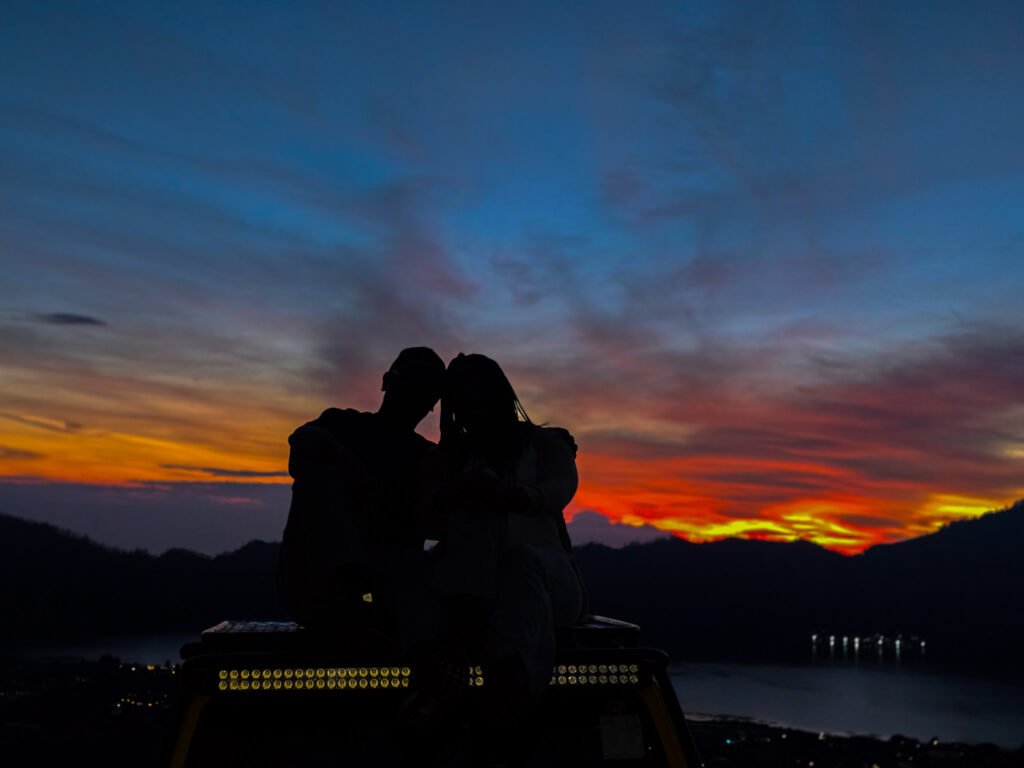
The sky went from black to deep blue to a burning band of orange and red along the horizon, the silhouette of Mount Agung rising in the distance as Mount Batur’s caldera emerged in the foreground. It was one of those mornings that earns the early alarm without question.
After the sunrise, the tour continued to the lava fields at the base of the volcano — a stark, otherworldly landscape left behind by the 1963 eruption of Mount Agung, where the hardened lava meets the edge of the living forest in a boundary that’s impossible to stand at and not feel something about.
Book through Viator and you’ll also earn cashback if you’re a Rakuten member — worth stacking if you use it regularly.
The Sacred Monkey Forest Sanctuary, Ubud
The Sacred Monkey Forest Sanctuary in Ubud is home to over 1,000 long-tailed Balinese macaques living freely across a dense, ancient forest that also functions as a working Hindu temple complex. The monkeys are wild, confident, and entirely unintimidated by visitors.
Marge sat down on a bench. A monkey promptly climbed up and made itself comfortable on her lap. The expression in the photograph — somewhere between delight and mild alarm — is the most accurate record of what the Monkey Forest is actually like. You don’t visit the monkeys here. You move through their space and they decide what to do about it.
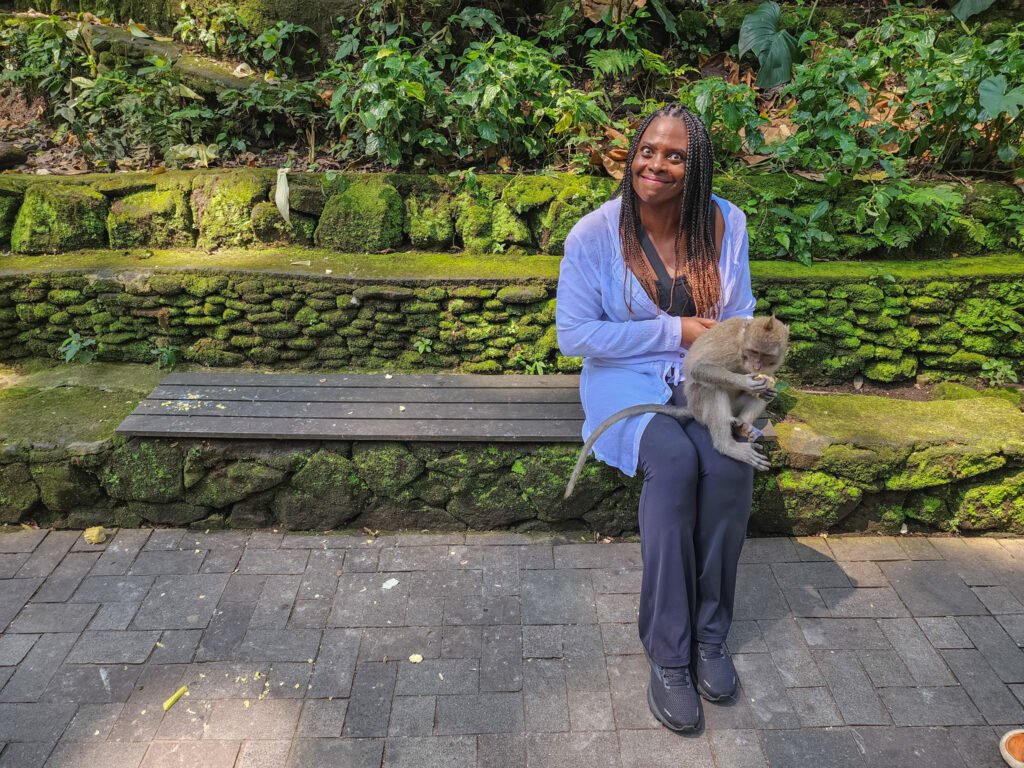
Go early, keep your bags secured, don’t carry food openly, and enjoy it. It’s one of those experiences that produces photos you’ll actually show people.
Kopi Luwak: The Coffee That Requires a Decision
We visited a coffee farm in the Ubud highlands where several varieties of Balinese coffee and tea are produced — and where Kopi Luwak is offered for tasting.
For the uninitiated: Kopi Luwak is made from coffee beans that have been eaten and naturally processed — excreted — by the Asian palm civet. The digestive process is said to alter the beans’ chemical composition and produce a distinctively smooth, low-bitterness cup. It is, by volume, one of the most expensive coffees in the world.
Mike tried it. Marge did not.
Mike’s verdict: smooth, genuinely different from standard coffee, and an experience worth having once. Marge’s verdict: some decisions require no explanation.
The farm itself is worth the visit regardless of the Kopi Luwak question — the setting is beautiful, the tasting flight of standard Balinese coffees and herbal teas is generous and included, and it’s a peaceful hour in the highlands.
Tirta Empul Temple
Tirta Empul is a Hindu water temple built around a natural spring that Balinese Hindus consider sacred and purifying. Worshippers enter the pools and move through a sequence of fountain spouts as part of a ritual cleansing — one of the most genuinely moving religious practices we’ve observed anywhere in Southeast Asia.
We chose not to participate in the bathing ritual, wanting to observe rather than move through as tourists in what is an active place of worship. The atmosphere is extraordinary — ceremonial, deliberate, and completely alive with genuine faith rather than performance. It’s one of those places that commands a different kind of attention than the average attraction.
Dress respectfully — a sarong is required and available to rent at the entrance. Take your time.
Tegalalang Rice Terrace
The Tegalalang Rice Terrace north of Ubud is genuinely beautiful — layers of sculpted green cascading down a valley in the traditional subak irrigation system that earned Bali’s cultural landscape its UNESCO status. It’s also genuinely busy, and the commercial activity around the main viewpoints has grown considerably with tourism.
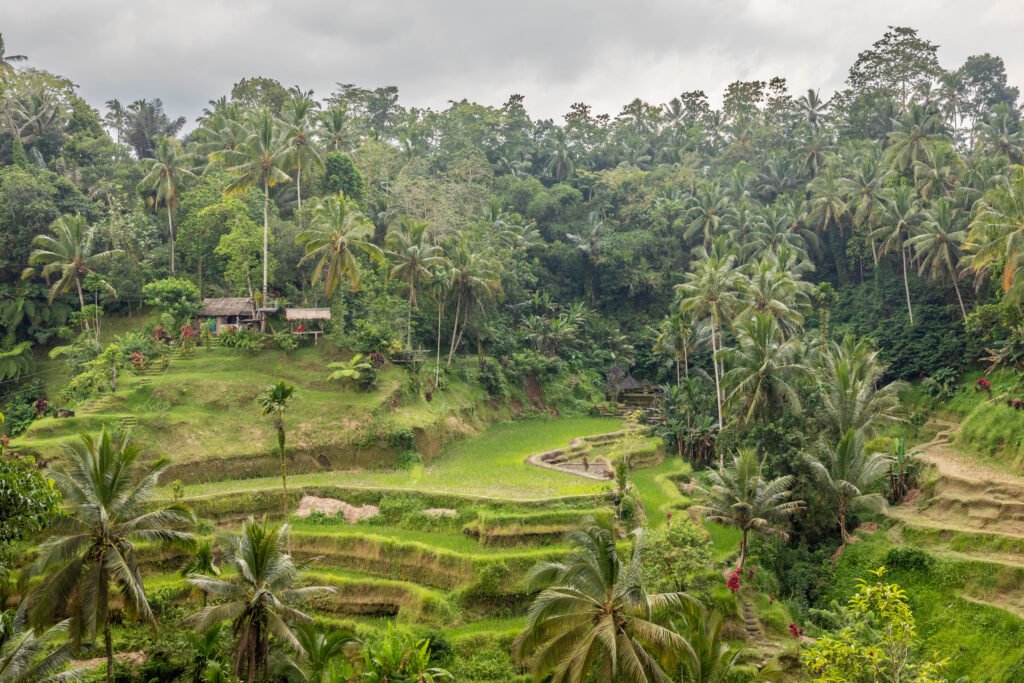
Go early. The light is better, the crowds are thinner, and the walk through the terraces before the vendors are fully set up has a completely different quality from the midday rush.
Tegenungan Waterfall
A solid half-morning — a substantial waterfall in a jungle gorge, accessible via a steep staircase, surrounded by lush vegetation and the kind of humidity that reminds you where you are. Busy by mid-morning. Again: go early.
The Bali Native House
We visited a traditional Balinese family compound — the kind of multigenerational home that has been passed between families for centuries and maintains the architectural and spiritual characteristics that define Balinese domestic life. We toured the outer grounds with a guide who walked us through the layout and history: the family temple, the separate pavilions for different household functions, the ornate stone carvings that aren’t decoration but language.
It’s quiet and specific in a way that the bigger sites aren’t. Worth including if you want to understand something about how Bali actually functions beyond the tourist circuit.
Where We Ate
Bendino Steak & Wine House was a genuine standout — well-executed, relaxed, and the kind of restaurant you return to. We did.
Natys Restaurant Jimbaran was another favourite — good local food, honest prices, and the kind of neighbourhood spot that rewards staying in Jimbaran rather than always heading into Seminyak.
La Brasserie by Melting Wok delivered a solid international menu in a comfortable setting — worth knowing about for an evening when you want something varied.
Bella Cucina, the hotel’s Italian restaurant, was better than onsite hotel dining has any right to be. Genuinely good food, well-executed, easy to overlook and worth not overlooking.
Sunset Beach Bar and Grill is where we celebrated Mike’s birthday, and it earned the occasion. An open-air restaurant directly on the beach, the Indian Ocean in front of you, the sun dropping toward the horizon — the food was excellent, the setting was better, and the evening had the particular quality of a birthday dinner that actually works rather than just happening. The music, the view, the meal. We’d go back.
The hotel breakfast was consistently strong — wide selection, high quality, and served by staff who made the start of each day genuinely pleasant. Don’t skip it.
Getting Around
For Bali slow travel, Grab is your primary tool. Download the app before you arrive and use it for airport transfers, day-to-day movement, and anything that doesn’t involve a full-day excursion.
For excursions — Mount Batur, Tirta Empul, the rice terraces, the coffee farm — we used Viator, which organises drivers and guides for full-day tours efficiently. If you’re a Rakuten member, booking through Viator earns cashback on your Amex card, which stacks nicely.
Local Tips & Etiquette
- Dress modestly at temples. Shoulders and knees must be covered — sarongs are available to rent at most temple entrances. This is not optional and is enforced.
- Offerings on the ground: Small woven palm-leaf baskets with flowers, incense, and food appear on footpaths and doorsteps throughout Bali as daily Hindu offerings. Step around them, not through them.
- Bargaining is expected at markets and with unlicensed drivers. Use Grab for transport to avoid negotiation entirely.
- Cash: Carry Indonesian Rupiah. Many local warungs, markets, and smaller vendors are cash only. ATMs are available in tourist areas but use reputable ones attached to banks.
- Tap water: Don’t drink it. Stick to bottled water consistently.
- Bug spray and sunscreen: Both essential, particularly for outdoor excursions and the rice terraces.
- The traffic in south Bali — Seminyak, Kuta, Legian — can be genuinely bad during peak hours. Factor it into your timing, particularly for early morning excursions.
- Respect the culture. Bali’s Hindu culture is not a backdrop — it’s the living reality of the island. Approach it accordingly.
Connectivity
Hotel Wi-Fi at the InterContinental was reliable throughout. Mobile data across the island was solid for day-to-day use. Sort data before you arrive with an Airalo eSIM —grab one here and save 15% on your first eSIM
Final Thought
Bali is not our favourite stop in Asia — and we think being honest about that is more useful to you than performing enthusiasm we didn’t fully feel. After months in Vietnam, Malaysia, Thailand, and Singapore, the tourist infrastructure of south Bali felt heavy in comparison, and parts of the island have been shaped so thoroughly by the volume of visitors that the original thing you came to find can take some effort to locate.
But the original thing is still there. It’s at Tirta Empul at dawn, in the rice terraces before the crowds, at the top of Mount Batur with the sky on fire behind the caldera. It’s in a monkey deciding Marge’s lap looks comfortable, and in a birthday dinner on the beach where everything came together without trying.
Bali slow travel delivered — it just required a little more looking than some of the places we’ve been.
🎬 Watch the Full Video
We documented the whole journey — Ubud, the temples, the volcanoes, and a birthday we didn’t see coming — on our YouTube channel. Watch it here:
▶️ 9 Days in Bali — Temples, Volcanoes & a Very Unexpected Birthday
If you’ve been to Bali, or you’re planning a trip, drop us a comment below — we’d love to hear where it took you.
— Mike & Marge | The Passport Pillow Slow travel for curious souls.