We’d been moving fast for months. After leaving Cambodia, Luang Prabang slow travel was exactly what we needed — not a nice idea, but a necessity. The schedule had been showing for weeks: early flights, packed itineraries, always somewhere else to be. By the time we landed at the end of February 2026, we were ready to stop performing tourism and simply be somewhere.
Luang Prabang made that easy. Sitting at the confluence of the Mekong and Nam Khan rivers, the city has a kind of quiet authority to it — the kind that makes rushing feel not just unnecessary, but slightly embarrassing. UNESCO listed it as a World Heritage Site in 1995, and the blend of traditional Lao architecture, French colonial buildings, and riverside temples has been carefully preserved ever since. It doesn’t feel like a museum, though. It feels lived in.
We spent seven days here. This is what that week looked like.
Where We Stayed: The Belle Rive Boutique Hotel
The Belle Rive is a small riverside property — just 16 rooms spread across a handful of beautifully restored colonial buildings. It sits in a quieter section of the city, far enough from the main strip to feel peaceful, close enough to walk to temples, restaurants, and the night market without any effort.
We booked a Balcony Maisonette with Mekong River views. The room has a mezzanine sleeping area and a private balcony that made mornings genuinely difficult to leave. At around $125 USD per night, the value — given the location, the quality, and the service — was excellent for a boutique property of this standard.
One practical note: some rooms are on upper floors and there’s no elevator. It wasn’t a problem for us, but worth keeping in mind if that’s a concern.
The front desk staff went well beyond what we expected. When we mentioned we needed train tickets onward to Vang Vieng, they handled the entire booking for us — which, as we’d soon discover, was no small thing. More on that below.
Would we stay again? Without question.
What We Did
Breakfast on the Mekong
Each morning, the Belle Rive Terrace became our routine. The hotel’s outdoor restaurant sits directly across the street on the banks of the Mekong — watching longboats drift past while breakfast arrived became one of those small rituals that end up defining a trip. The staff here matched the warmth of the front desk: unhurried, attentive, genuinely welcoming.
If you stay at the Belle Rive, bring your own mosquito repellent for the terrace mornings. The hotel provides some in the rooms, but you’ll want it to hand.
Living Land Rice Farming Experience
This was the highlight of the week — and we weren’t expecting it to be.
Living Land is a community-run farm located just outside the city, set among rice fields with mountain scenery behind. The experience runs about three and a half hours, covers every stage of rice production from planting through harvesting and processing, and includes lunch. Cost is $48 USD per person.
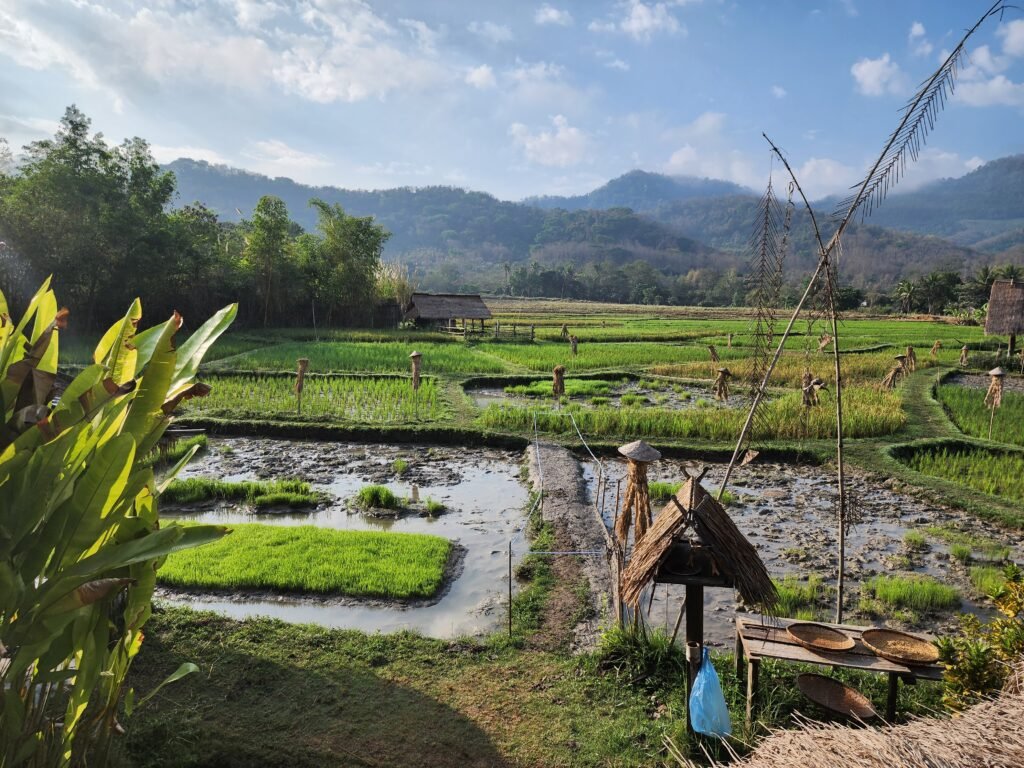
What sets it apart is that you’re not a spectator. You’re in it. The moment that will stay with us longest: Marge guiding an ox through a muddy rice field, knee-deep in mud, looking both completely out of her element and completely delighted. It’s the kind of thing you can’t stage, and it’s the kind of thing you don’t forget.
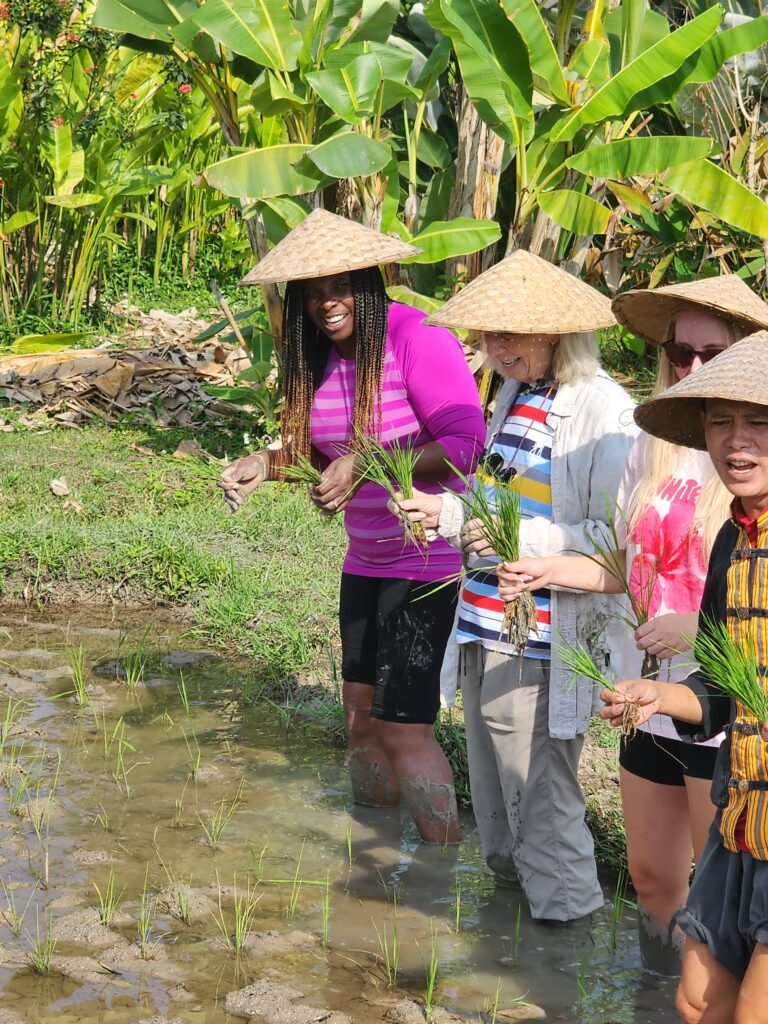
For anyone looking for an experience that’s genuinely educational without being performative about it, this earns a strong recommendation.
Big Brother Mouse
This one wasn’t in any guidebook we consulted. Big Brother Mouse is a local educational charity that connects Lao students with English-speaking visitors for informal conversation practice — the goal being to build confidence and language ability in a relaxed, low-pressure setting.
We spent time there one afternoon, paired with a young student who asked us questions about our travels while we asked her about life in Laos. The whole exchange was in English. It cost nothing but an hour of our time, and it was one of the most genuinely memorable afternoons we’ve had in Southeast Asia.
Travel has a habit of optimising for the photogenic. Big Brother Mouse is a reminder that the most lasting moments usually happen in conversation.
Sunset Cruise on the Mekong
One evening we joined a sunset cruise on the river. As the sun dropped behind the surrounding hills, the Mekong caught the light in a way that’s genuinely hard to describe without reaching for clichés — so we’ll just say the photographs came out well, and leave it at that.
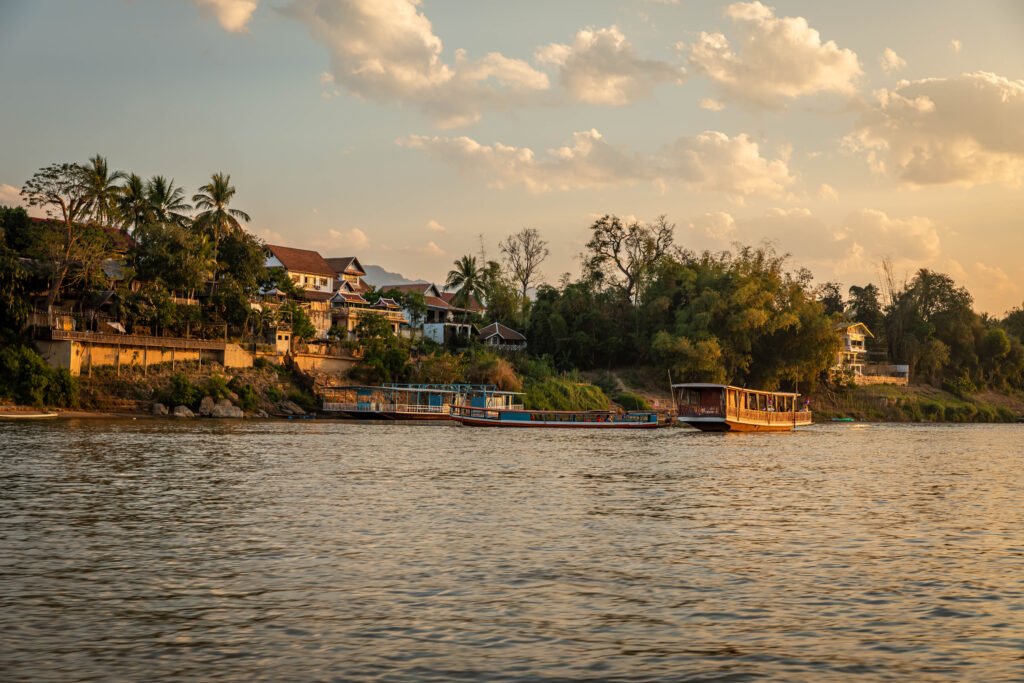
Even if photography isn’t your thing, it’s a lovely way to feel the pace of the place. The river slows everything down.
Where We Ate
Belle Rive Terrace
Beyond breakfast, the Terrace served as a reliable fallback for easy evenings. The food is straightforward, the Mekong views do a lot of the heavy lifting, and the service is consistently good.
Manolo’s Mexican Eatery
Yes, Mexican food in Luang Prabang — and it worked. The chicken fried rice and spring rolls were solid, the outdoor riverside setting was lovely, and the whole evening had the relaxed feel of a proper date night. It’s not going to redefine your understanding of Mexican cuisine, but it doesn’t try to. The setting does the job, the food is good, and that’s plenty.
Princess Restaurant at Villa Santi Hotel
A more polished option — a bit more formal in atmosphere without being stiff about it. Worth knowing about if you want something a step up from a casual evening without committing to a full fine-dining production.
Luang Prabang Slow Travel: Practical Tips
- Getting there: We flew Vietnam Airlines from Siem Reap. The flight is short and straightforward. Luang Prabang’s airport is small and easy to navigate.
- Getting around: The historic center is easily walkable. Tuk-tuks are available for anything further afield. The Living Land farm is a short ride outside the city.
- Connectivity: An Airalo eSIM is the easiest option for connectivity in Laos — active before you land, no SIM-swapping required. Grab one here with 15% off using our referral link.
- For a full breakdown of the apps we use on every trip, see The Only Travel Apps You Actually Need.
- Weather: We visited in late February, which sits in the dry season — warm, manageable heat, and minimal rain. The cool-season window from November through February is generally the most comfortable time to visit.
- Hydration: Carry water whenever you’re out. The heat is steady, and the temples involve more walking than they look like they will.
- Cash vs. card: Bring Lao Kip for markets and smaller vendors. Cards are accepted at most hotels and restaurants but don’t count on it at smaller spots.
- Tipping: Not culturally expected but genuinely appreciated, particularly at smaller family-run restaurants and by tuk-tuk drivers.
- Dress code: Cover shoulders and knees for temple visits. This is taken seriously and rightly so.
- Train tickets onward: If you’re continuing south by rail, ask your hotel to book your Laos-China Railway tickets as soon as you arrive. The trains are popular, tickets move quickly, and some booking systems require a Lao phone number that foreign visitors don’t have. Your hotel can sort it. Ours did.
Getting to Vang Vieng: The Laos-China Railway
After seven days it was time to move on, and we did it by train — specifically, the Laos-China Railway, which has transformed overland travel in this country.
The station is modern, large, and impressive. Our travel day was crowded — boarding involved long queues that compressed into general crowds at the doors, and if you’re travelling with luggage, manage your expectations accordingly. Once onboard, all of that disappears.
We booked Business Class, which runs roughly $18–25 USD per person (Second Class is around $7.66–13, First Class $13–19 — exact fares vary by train). The extra cost over Second Class is modest and the difference in comfort is meaningful: more space, a quieter atmosphere, a much more pleasant journey through the Lao countryside.
The train itself is fast, clean, and efficient. What was once a lengthy overland slog is now a relaxed ride. Book Business Class. It’s worth it.
Final Thoughts
Before we arrived, we expected to enjoy Luang Prabang. We didn’t expect to feel genuinely restored by it.
The city has a quietness that isn’t emptiness — it’s more like the place has decided on a pace and stuck to it, and after a while you stop resisting and simply adjust. Seven days felt right. Maybe more would have too.
If you’re routing through Laos, don’t rush this one.
🎬 Watch the Full Video
We documented our week in Luang Prabang — from muddy rice fields to Mekong sunsets — on our YouTube channel. We’re working on the video now and will link it here when it’s live. In the meantime, find all our travel videos at youtube.com/@milowes43.
If you’ve spent time in Luang Prabang, or you’re planning a trip, drop us a comment below — we’d love to know what it did for you.
— Mike & Marge | The Passport Pillow
Slow travel for curious souls.