We flew Qatar Airways from Atlanta to Bangkok — economy class, with a layover in Doha — and arrived better rested than either of us expected. Qatar’s economy product is genuinely a cut above: attentive service, real meals, comfortable enough seats that the long haul felt manageable rather than punishing. It set the trip off on the right foot before we’d even landed.
Two weeks of slow travel Thailand — Hua Hin to Bangkok. A cave pavilion glowing in jungle light, Bangkok by bike, and an anniversary dinner above the coast.
From Bangkok we headed straight to the coast. Two weeks in Thailand, two cities, one anniversary dinner with our oldest son that we won’t forget in a hurry. Thailand has a way of doing that — of producing moments you didn’t see coming.
Week One: Hua Hin
Getting There & Settling In
A private taxi from Bangkok’s Suvarnabhumi Airport to Hua Hin runs about three hours, depending on traffic, and costs a fraction of what you’d pay for comparable transfers elsewhere in the region. We booked in advance and the ride was smooth — a good first look at the Thai countryside before the coast came into view.
Our base was a quiet Airbnb just outside the city centre — unhurried mornings, easy access to markets and the beach, and exactly the kind of neighbourhood rhythm that makes a longer stay feel lived-in rather than transient.
Hua Hin itself is a different proposition from the more famous Thai beach resorts. It has royal history — the summer palace is nearby, and the town carries itself accordingly — and a local pace that suited us perfectly as a first week in the country. Less backpacker energy, more early morning beach walkers and very good coffee.
The Phraya Nakhon Cave
If you’re in Hua Hin, this one is non-negotiable.
Located in Sam Roi Yot National Park, about an hour’s drive south, the experience involves a short boat crossing followed by a hike up a forested hillside that earns its destination. At the top, a collapsed cave opens to the sky — and sitting inside it, lit by a shaft of natural light filtering down through the opening, is a royal pavilion built in 1890 for King Rama V.
The image of that structure — ornate, golden, glowing in the beam of light inside a cave — is one of those things that photography doesn’t quite capture and description doesn’t quite do justice. Go in the morning when the light angle is right, bring water, and pace yourself on the hike up. Every bit of the effort is worth it.
Monsoon Valley Vineyard
This was the day we didn’t expect to love as much as we did.
Monsoon Valley Vineyard sits in the hills outside Hua Hin and produces some of Thailand’s most recognised wines — a fact that still surprises people who assume the country’s climate isn’t suited to viticulture. The vineyard has found its own way around that, and the result is worth tasting.
We toured the vines, took in panoramic views across the countryside, and had a long, unhurried lunch that became one of the most relaxed afternoons of the whole trip. It’s the kind of place that doesn’t feel like a tourist attraction even when it clearly is. Calm, scenic, genuinely good food. If you have a free afternoon in Hua Hin and want something completely different from the beach, go here.
The Markets
Hua Hin has markets for every mood and hour. We stocked up on groceries at Lotus in Market Village Mall — practical and well-stocked for Airbnb living — then spent our evenings working through the Hua Hin Night Market, where grilled seafood, mango sticky rice, and fresh juices come at prices that still seem implausible by Western standards.
On the weekend, the Cicada and Tamarind night markets are worth the trip — more curated, with live music, handmade goods, art, and street food that skews slightly more creative than the standard stalls. The atmosphere on both evenings was genuinely lively without tipping into overwhelming.
The Anniversary Dinner — Vana Nava Sky
We celebrated our wedding anniversary at the Vana Nava Sky Bar & Restaurant, perched at the top of the Holiday Inn Resort in Hua Hin, and it was the right choice for all the right reasons.
Our oldest son was with us for this part of the trip, which made the evening feel like something more than just a nice dinner — it was one of those unexpectedly full moments that travel occasionally delivers. The three of us sat with panoramic views across the Hua Hin coastline, ate filet mignon, and took our time about it.
The restaurant has since rebranded as The Sky, and the filet mignon we had may no longer be on the menu — but the setting remains, and the views haven’t moved. If you’re marking a special occasion in Hua Hin, this is the place to do it. There’s a glass walkway for anyone who wants an extra layer of occasion.
Week Two: Bangkok
Where We Based Ourselves
We stayed in Ekkamai, just east of Sukhumvit, and it was one of the better base decisions we’ve made in a city stay. Ekkamai sits in a particular sweet spot — genuinely local in feel, with neighbourhood cafés and restaurants and a pace that doesn’t try to compete with the tourist-facing parts of the city, but with excellent BTS Skytrain access that puts the whole of Bangkok within reach.
Boutique malls, a Japanese shopping alley, relaxed evening options — and the kind of streets that reward wandering without an agenda. For slow travellers who want to be in Bangkok without feeling engulfed by it, Ekkamai is the answer.
Benchakitti Park
Our first full morning in Bangkok started on two wheels.
Benchakitti Park sits just south of Sukhumvit, an easy ride from Ekkamai, and it turned out to be one of the better decisions we made in the city. We rented bikes at the park entrance and spent a few hours looping through it — no particular agenda, just moving at whatever pace felt right and stopping whenever something caught our eye.
The park is more impressive than its central-city location suggests. A wide cycling and walking path rings the lake, with the Bangkok skyline rising behind the treeline in a way that shouldn’t work as well as it does — glass towers and green canopy sharing the same frame. Early morning is the right time to be here: locals out walking, the air still carrying a hint of cool, the city not yet fully in motion.
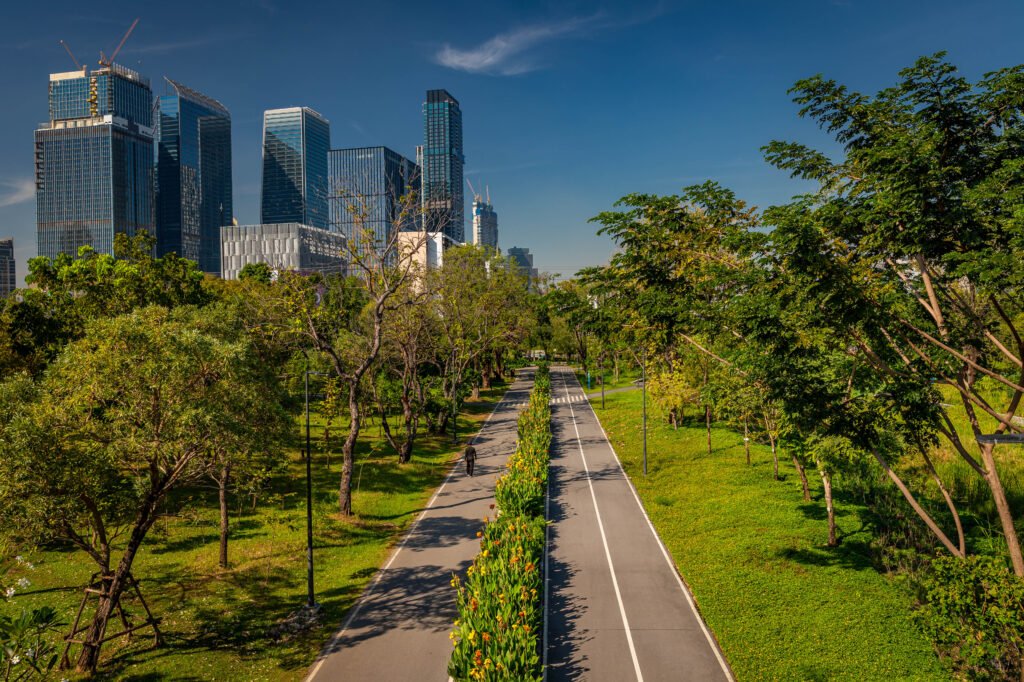
It’s not a place most visitors put at the top of their list, but it earned its own paragraph because it gave us something the temple circuit can’t: a slow, unhurried start to a Bangkok day with no entrance fees, no dress codes, and no queue. If you’re based anywhere near Sukhumvit, go before breakfast.
The Temples
Bangkok’s temple circuit justifies every word written about it, which is saying something given how much has been written.
We started early at the Grand Palace and Wat Phra Kaew — early being the operative instruction, before the heat and the tour groups both arrive in full force. The Grand Palace’s scale and ornamentation is genuinely staggering up close in a way that photographs don’t fully convey.
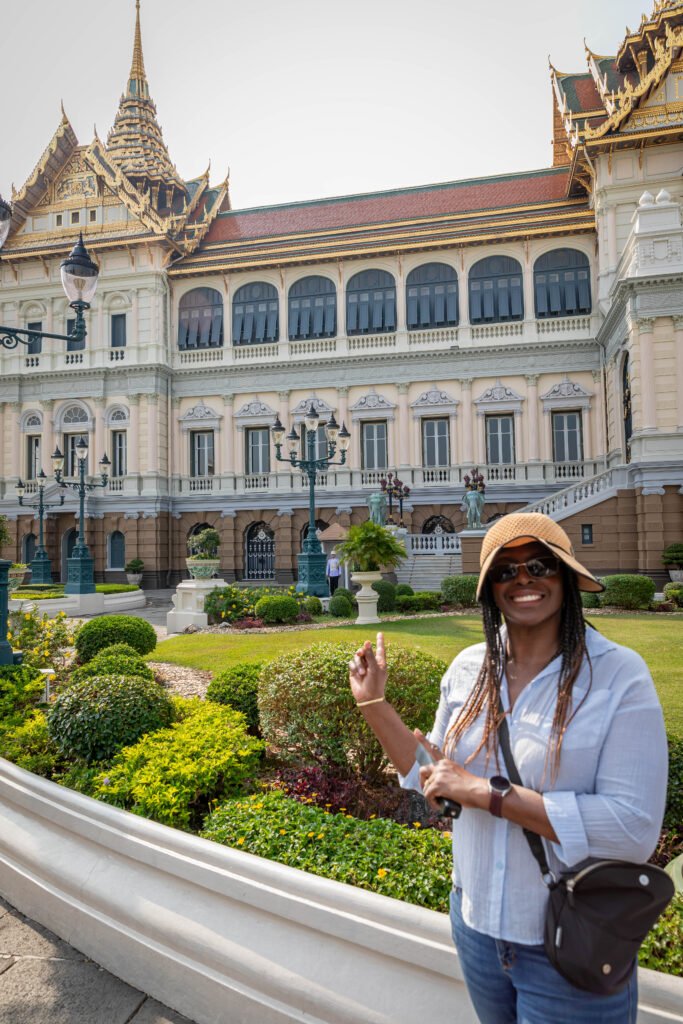
Wat Pho came next, home to the famous reclining Buddha — 46 metres long, gold-leafed, occupying an entire building that still somehow feels too small for it. From there, the ferry across the Chao Phraya River to Wat Arun is one of Bangkok’s essential journeys, short as it is. Climb the temple’s steep central prang for the river panorama. It’s worth the slightly vertiginous descent.
Chinatown
Bangkok’s Chinatown — Yaowarat — operates at a register entirely its own. Narrow streets, roast duck hanging in windows, handmade noodles pulled to order, desserts that defy easy description and reward adventurous ordering. It’s the kind of neighbourhood where you abandon the plan, follow your nose, and accept that you’ll eat better than you could have chosen.
Go in the evening when the street food stalls are fully operational. Arrive hungry. Leave with no idea what half of what you ate was called, and no particular desire to find out.
Ayutthaya Day Trip
The former capital of the Kingdom of Siam sits about 80 kilometres north of Bangkok and deserves a full day. We joined a guided tour, which handled the logistics and added context that solo exploration would have missed.
Wat Mahathat is the most photographed site — home to the famous sandstone Buddha head cradled in the roots of a bodhi tree, an image that somehow remains striking no matter how many times you’ve seen it reproduced. Wat Phra Si Sanphet, with its row of three restored chedis, has a different quality — quieter, more imposing, the kind of ruin that puts time into perspective.
Bring a hat, sunscreen, and more water than you think you’ll need. Almost everything is outdoors, the sun is relentless, and the site is large enough that you’ll cover more ground than you expect.
ICONSIAM & Chatuchak
ICONSIAM on the Chao Phraya riverfront is worth a visit as much for the architecture and setting as the shopping — though the basement food hall, which recreates a Thai floating market indoors, is an experience in itself.
Chatuchak Weekend Market, if your dates align, is enormous, chaotic, and genuinely excellent. Vintage clothing, handmade ceramics, street food, live animals (unexpected), and enough variety that you’ll cover only a fraction of it in a morning. Bring cash, pace yourself, and leave room in your bag.
Dinner at SEEN
We ended the trip at SEEN, the rooftop restaurant overlooking the Chao Phraya River, and it was the right note to finish on.
The views of the river at night — the lights of Bangkok reflecting off the water, the boats moving below, the skyline in every direction — are spectacular in a way that makes you want to sit with your drink and not rush toward anything. We had the striploin and the baked Ora King salmon, both excellent, and took our time.
Note: SEEN has a dress code. Check it before you go — they enforce it.
Practical Tips for Two Weeks in Thailand
These practical tips cover everything you need for slow travel Thailand done right.
- Getting between cities: Private taxi from Bangkok to Hua Hin runs 3–4 hours and is the most flexible option with luggage. Book in advance through your accommodation.
- Bangkok base: Ekkamai gives you local feel with good BTS access. Avoid basing yourself in the most tourist-dense areas if you want any kind of neighbourhood experience.
- Temples: Shoulders and knees must be covered at all religious sites. Carry a light layer or a sarong if you’re planning a temple-heavy day.
- Heat: Relentless, particularly between 11am and 3pm. Plan outdoor sightseeing for early morning, use the middle of the day for indoor attractions or a meal, and get back out in the late afternoon.
- Bug spray and sunscreen: Non-negotiable, particularly for outdoor sites like Ayutthaya and Phraya Nakhon Cave.
- Connectivity: Pick up a local SIM at the airport on arrival, or sort it before you land — an Airalo eSIM works before you even land. grab one here and save 15% on your first eSIM
- Cash: Still essential in markets, smaller restaurants, and most temple entrance fees. ATMs are widely available but check your card’s foreign transaction fees.
- Grab: Use it. Reliable, cheap, and infinitely preferable to negotiating with unlicensed taxis.
Two weeks of slow travel Thailand moved at exactly the right pace — slow enough to actually feel Hua Hin, busy enough to cover Bangkok properly without sprinting through it. The cave pavilion glowing in its shaft of light, the vineyard lunch, the anniversary table with our son, the morning ride through Benchakitti with the skyline coming through the trees, the river from the SEEN rooftop — the trip produced the kind of specific memories that don’t fade.
Thailand rewards the slower approach. Give it the time it deserves. If Southeast Asia has your attention, our Cambodia post covers Angkor Wat, Phnom Penh, and the temples that stopped us in our tracks.
🎬 Watch the Full Video
We documented two weeks in Thailand — Hua Hin to Bangkok — on our YouTube channel. Watch it here:
▶️ Two Weeks in Thailand: Hua Hin & Bangkok | The Passport Pillow
If you’ve been to Thailand, or you’re planning a trip, drop us a comment below — we’d love to hear where it took you.
— Mike & Marge | The Passport Pillow Slow travel for curious souls.