We’ll be honest — Cambodia wasn’t at the top of our list. It was more of a “while we’re in the region” decision. And that, as it turns out, was one of the best mistakes we’ve made in years of slow travel.
What we found in Cambodia wasn’t what the tourist brochures sell. It was heavier in places, more joyful in others, and almost universally unexpected. This country has survived something unimaginable, and yet its people carry a warmth and resilience that you feel the moment you arrive. Two cities, ten days, and we’re already talking about going back.
Here’s how it went.
Phnom Penh: Four Days in the Capital
Where We Stayed
We checked into the IHG Crowne Plaza Phnom Penh, a relatively new addition to the IHG portfolio — new enough that a few things were still being ironed out operationally. But here’s the thing: the staff made up for every small hiccup. Kind, genuinely accommodating, and eager to help in a way that felt authentic rather than scripted. As IHG members, we’ve stayed at a lot of Crowne Plazas. The property itself was solid, but the people running it were the real selling point.
Practical note: If you’re an IHG One Rewards member, Cambodia is a great place to burn points. Newer properties often offer strong value before rates climb with reputation. We’ve had consistently good experiences with IHG across Southeast Asia — including the Crowne Plaza in Penang during our three months in Malaysia.
The Royal Palace
Start here. The Royal Palace is exactly what it sounds like — a gleaming complex of golden spires, emerald green tile roofs, and manicured grounds that sit right along the Tonlé Sap River. It’s stunning in the midday heat (and Phnom Penh heat is no joke — more on that later).
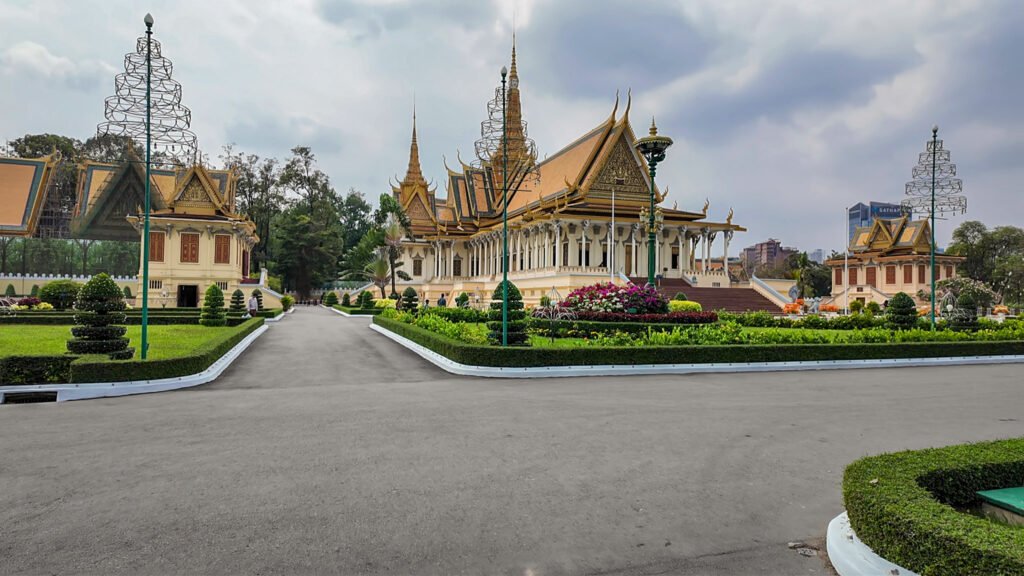
The Silver Pagoda, housed within the palace grounds, is the highlight. The floor is made of over 5,000 silver tiles, and the room holds a collection of Buddha statues, some encrusted with diamonds. Dress modestly — shoulders and knees covered — and allow at least two hours to wander properly.
The Genocide Museum — A Place That Demands Your Full Attention
We’re going to shift tone here for a moment, because this deserves it.
The Tuol Sleng Genocide Museum — known as S-21 — is a former high school that the Khmer Rouge converted into a brutal detention and interrogation centre between 1975 and 1979. It is one of the most sobering places either of us has ever stood inside.
The photos. The rooms. The silence that hangs over the whole place even when it’s crowded.
We made the decision not to film inside the museum, and we’d make that same call again without hesitation. Some places aren’t content — they’re testimony. Tuol Sleng is one of them. You walk through it slowly, you read the names, you sit with what happened. That’s the only appropriate response.
Go. It’s difficult and it should be. That’s exactly why it matters.
Tip: Audio guides are available and highly recommended. They provide crucial context that solo exploration alone can’t fully convey.
The Killing Fields of Choeung Ek
Located about 15 kilometres outside the city centre, Choeung Ek is where an estimated 17,000 people were executed during the Khmer Rouge regime. It is now a memorial site — quiet, green, and profoundly heavy.
The Memorial Stupa at the centre contains the remains of victims recovered from the mass graves, still being discovered and excavated today. The audio guide here — narrated in part by a survivor — is unlike anything we’ve experienced at any memorial, anywhere. By the time it ends, you’ll understand Cambodia differently.
We left Choeung Ek quieter than we arrived. That feeling stayed with us for a while, and that’s exactly as it should be.
We recommend visiting the Killing Fields and Tuol Sleng on separate days if possible. Both experiences are emotionally demanding — trying to absorb both in one day does a disservice to each.
The Lighter Side of Phnom Penh
Cambodia has a way of holding grief and joy in the same hand, and you feel that most acutely along the Phnom Penh Riverwalk.
After a long, hot afternoon exploring the city, we stumbled into Lagràce Café on Street 178 — a cool, calm retreat from the heat with good coffee and the kind of atmosphere that makes you want to stay longer than you planned. If you’re wandering that stretch of the city and need a pit stop, this is it.
For dinner, we ended up at Oskar Bistro on Preah Sisowath Quay, right along the waterfront. This is a genuine recommendation, not a polite mention — the food was excellent, the setting was lovely, and by the time we finished and stepped back outside, dusk had transformed the Riverwalk into something else entirely.
As night fell, the whole promenade came alive. Vendors set up along the river, locals gathered in groups, kids ran between the stalls, and the city exhaled. We wandered for a long time, eventually making our way through the Night Market, where the energy, colour, and smell of street food all collide in the best possible way.
Phnom Penh at night is a city that knows how to breathe.
The Road to Siem Reap
We hired a private taxi for the journey between Phnom Penh and Siem Reap — roughly six hours by car. With our check-in luggage and carry-ons, the flight would have been more hassle than it was worth, and the drive gave us something the airports couldn’t: the Cambodian countryside.
Rice paddies stretching to the horizon. Villages where life happens at the roadside. Monks in saffron robes cycling paths we couldn’t place on any map. It’s the kind of view that grounds a trip and reminds you why slow travel exists in the first place.
Cost comparison: Private taxi runs roughly $45–65 USD depending on the provider. A domestic flight, by the time you factor in airport transfers and baggage fees, rarely comes out cheaper or meaningfully faster.
Siem Reap: Temples, Rats, and Lotus Fields
Where We Stayed
The Golden Temple Boutique Hotel, tucked near the Angkor Night Market, was a find. Comfortable rooms, beautiful grounds, and — as with the Crowne Plaza — staff who were genuinely the highlight of the stay. The breakfast lounge team in particular deserves a special mention: attentive, warm, and the kind of morning presence that sets the tone for a good day. It’s boutique travel done right.
APOPO: Meet the Hero Rats
Before the temples, make time for the APOPO Visitor Centre in Siem Reap. It’s one of those places you don’t expect to love, and then you do.
APOPO is an organisation that trains African giant pouched rats — called HeroRATs — to detect landmines buried across Cambodia, a devastating legacy of decades of conflict that continue to kill and injure civilians today. The rats are ideal for the task: they’re light enough not to trigger the mines, they have extraordinary olfactory sensitivity, and they work quickly across large areas of land that would take human teams significantly longer to clear.
What makes it even more remarkable is that the same rats are also trained to detect tuberculosis in sputum samples, dramatically speeding up diagnosis in under-resourced healthcare settings.
The visitor centre walks you through the science, the training, and the real-world impact — and yes, you get to watch the rats work. It’s fascinating, it’s heartwarming, and it directly connects to Cambodia’s ongoing recovery from its traumatic history.
Go before the temples. It’ll give you context you’ll carry with you all day.
Angkor Wat at Sunrise
There is no other way to say this: set your alarm, go early, and don’t think twice about it.
We arrived at Angkor Wat in the pre-dawn dark along with hundreds of others, all of us gathered at the edge of the reflecting pool, waiting. As the sky lightened, the silhouette of those towers — five of them rising in that unmistakable formation — slowly emerged from the mist and began to catch the first pale gold of morning.
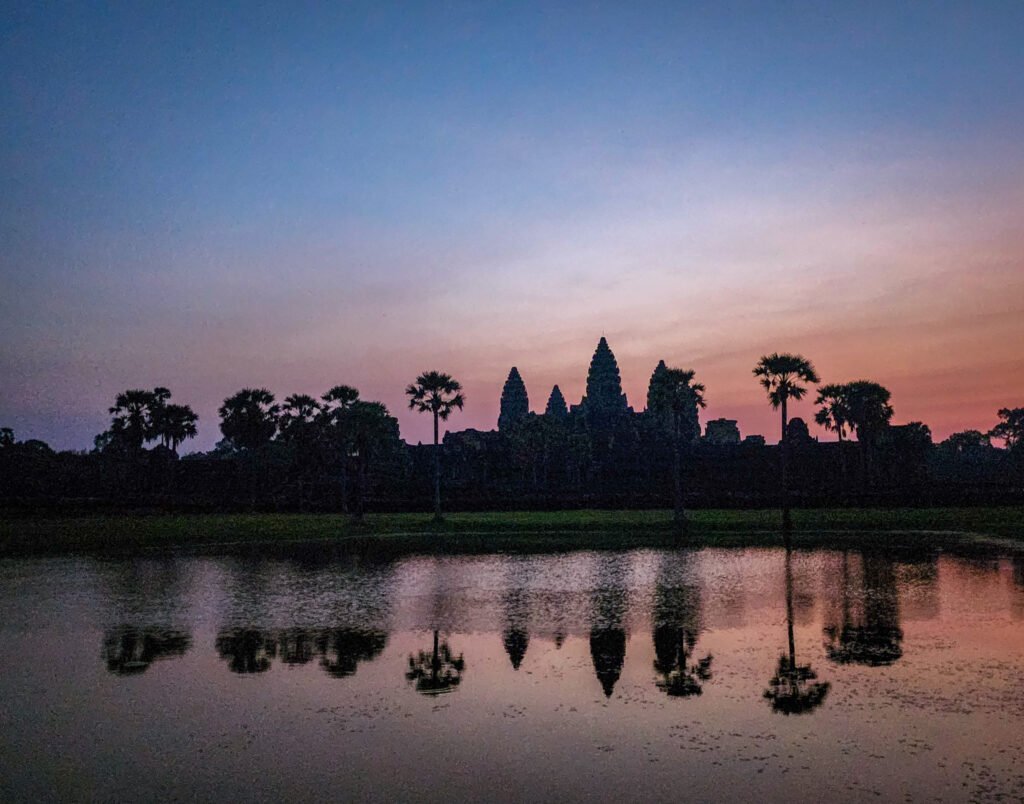
It is breathtaking. It was crowded. It didn’t matter.
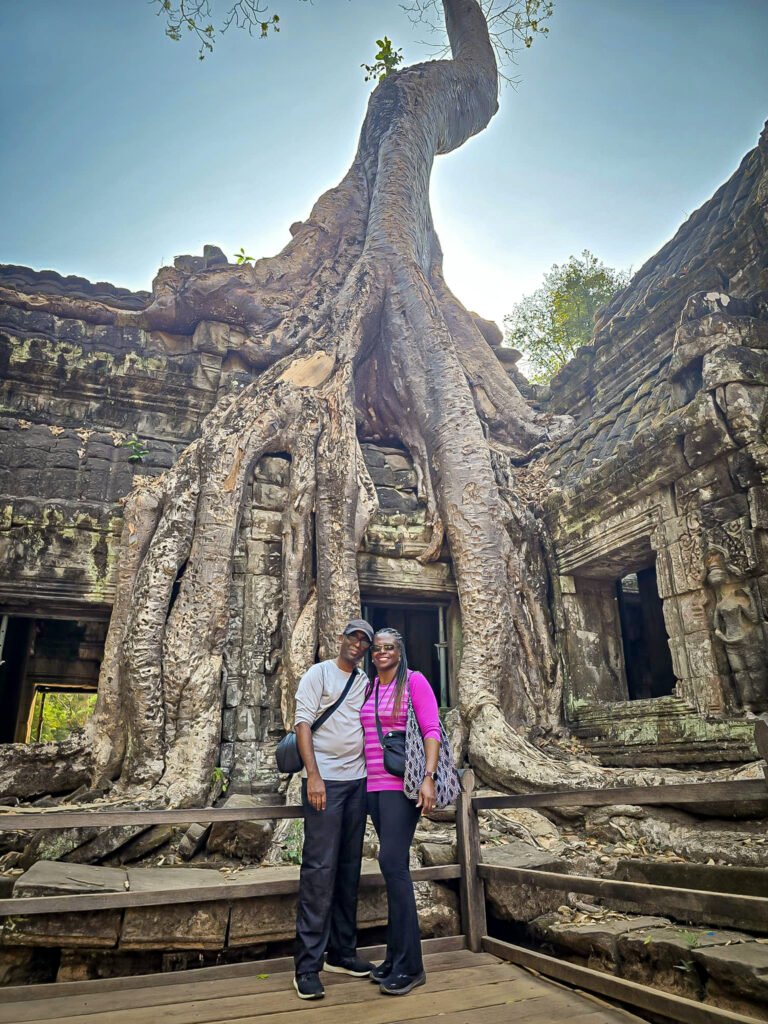
Angkor Wat is the largest religious monument on earth, built in the 12th century and spanning over 400 acres. A full day here barely scratches the surface — we also toured Ta Prohm, better known internationally as the Tomb Raider temple, where enormous tree roots have slowly consumed the stone ruins over centuries. It looks exactly like the set of a film because it literally was. It also looks entirely unlike anything else you’ll see on earth.
Practical notes:
- Purchase a temple pass in advance — 1-day ($37), 3-day ($62), or 7-day ($72). Worth it for multi-day exploring.
- Hire a tuk-tuk driver for the day to move between temples efficiently. Many drivers are excellent informal guides.
- Be at the Angkor Wat reflecting pool by 5:00–5:30 AM for the best sunrise position.
The Lotus Fields
This one was a last-minute addition and became one of our favourite afternoons in Cambodia.
The experience starts at a small centre where a guide demonstrates how the lotus plant is harvested and processed — the stems spun into thread, woven into fabric, and crafted into products that are remarkably soft and sustainable. It’s genuinely fascinating.
Then you board a small boat and head into the lotus fields themselves — wide expanses of pink and white blooms stretching across the water, impossibly peaceful, lit golden in the afternoon light. It was the kind of unhurried, unscheduled hour that makes slow travel worth every bit of the packing and planning that surrounds it.
Where We Ate in Siem Reap
Pub Street and its surrounding lanes are the heartbeat of Siem Reap’s food scene — lively, varied, and accessible at almost every budget. A few spots worth naming:
- Amara Dining (Pub Street) — great atmosphere, solid Khmer and international menu, perfect for an evening out
- Somaha Meat & Chill — a steak house and wine bar that punches well above its surroundings; go if you’re in the mood for something more Western without compromising on quality
- Indochine Restaurant & Bar — well-executed Southeast Asian cuisine in a setting that feels authentically regional without being touristy about it
And don’t overlook the smaller street vendors. Some of the best food we had in Siem Reap cost under two dollars and came from a cart on a side street. That’s Cambodia in a nutshell.
The Practical Stuff (Don’t Skip This Part)
Heat. Cambodia is hot. Not “warm afternoon” hot — genuinely relentless, draining heat. Carry water everywhere. Drink more than you think you need. Plan midday rest time into your itinerary rather than fighting through it.
Bug spray. Essential. Especially at the temples and the Lotus Fields where you’re near water and vegetation. DEET-based repellent is what works.
Sunscreen. Apply it before you leave the hotel. Reapply. Then reapply again. The equatorial sun is not subtle.
Connectivity. A local SIM is cheap and easy to get at the airport. Alternatively, an Airalo eSIM works before you even land —grab one here and save 15% on your first eSIM
Cash vs card. USD is widely accepted and often preferred in Cambodia. Carry small bills.
Final Thought
Cambodia surprised us in ways that still feel difficult to articulate. It’s a country that asks something of you — that you show up, pay attention, and hold both its tragedy and its beauty at the same time. We weren’t prepared for how much it would give back.
We’ll be returning. That’s about as honest a recommendation as we can offer.
🎬 Watch the Full Video
We documented the whole journey — Phnom Penh, the Killing Fields, the temples, and everything in between — on our YouTube channel. Watch it here:
▶️ Killing Fields, Angkor Wat & Everything In Between | Phnom Penh & Siem Reap
And if you’ve been to Cambodia, or you’re planning a trip, drop us a comment below — we’d love to hear where it took you.
— Mike & Marge | The Passport Pillow Slow travel for curious souls.
Pin this post for later or share it with someone who needs Cambodia on their radar.