We flew into Kuala Lumpur in early June after a four-day stop in Singapore, and didn’t leave until early September. Three months of actually living in Malaysia — long enough to stop being tourists, find favourite restaurants, navigate the healthcare system, and — in Marge’s case — wrestle a crab on Jalan Alor in front of a very entertained street full of locals.
Malaysia earned its place near the top of our slow travel list. Here’s the honest version of why.
Kuala Lumpur: Life in the KLCC
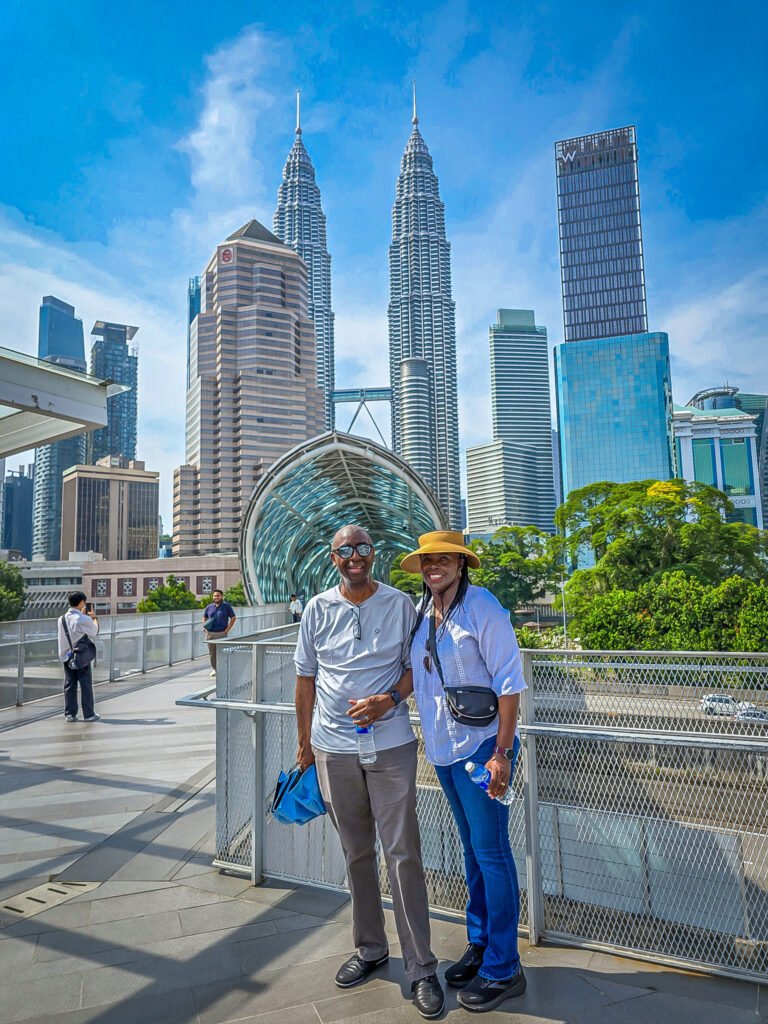
We based ourselves in KLCC — the heart of Kuala Lumpur, in the shadow of the Petronas Towers — and for a longer stay, the location paid dividends daily. Parks, malls, restaurants, and the MRT all within walking distance. When we needed to go further, Grab handled it quickly and cheaply — a fraction of what the equivalent ride would cost back home.
Daily life in KL has a particular ease to it. English is widely spoken, the infrastructure is genuinely first-world, and the city has a way of accommodating whatever pace you want to set. We visited the National Mosque, climbed the Batu Caves steps in the heat (worth every one of them), and found a local church for regular Sunday services. Independence Day celebrations caught us completely off guard — patriotic, colourful, and genuinely welcoming to a couple of Americans who had no idea what they’d wandered into.
One honest caveat on KLCC: it’s lively around the clock, and late-night motorcycle groups occasionally made that very clear through the early hours. If you’re sensitive to noise, choose your building carefully. Looking back, we’d consider Bukit Damansara for a quieter base that still keeps you well-connected.
The Food — Starting with That Crab
Malaysia is one of the great food countries on earth, and Jalan Alor in Bukit Bintang is where that claim gets tested at its loudest and most chaotic. It’s a street food strip that runs hot well into the night — smoke rising from charcoal grills, tables spilling onto the pavement, vendors calling from every direction.
Marge ordered the crab. What followed was a determined, extended, and ultimately only partially successful battle with a crustacean that had no intention of giving up its meat without a fight. The table next to us were openly entertained. The crab was delicious. These are the moments that end up in YouTube videos for good reason.
Beyond Jalan Alor, Malaysian food rewards patience and repetition. We worked through nasi lemak, roti canai, laksa, char kway teow, and cendol across three months and never got tired of any of them. Our favourite restaurant for something more relaxed was WIP On The Park — consistently good food, great service, and a vibe that sits comfortably between casual and refined. We went back more than once.
For the record, we also spent an hour at Aquaria KLCC — the city’s main aquarium, attached to the convention centre beneath the Towers. Perfectly pleasant, well put together, but primarily geared toward families with children. An hour was about right.
Healthcare Abroad — What It Actually Looks Like
This section matters, so we’re going to give it the space it deserves. One of the most common questions we get from people considering long-term travel past retirement is: what do you do about healthcare? Malaysia gave us a very direct answer.
The Medical Screenings — Prince Court Medical Centre
We completed comprehensive health screenings at Prince Court Medical Centre in Kuala Lumpur — a private hospital operating to international standards, with same-day results and a level of efficiency that would embarrass most Western systems we’ve experienced.
Mike’s package — Signature Male (Above 50 Years): RM 1,800 (~$433 USD)
The package covered everything from the routine to the thorough: full consultation and physical examination, vital signs, vision and hearing testing, body fat analysis, and dietary counselling. Laboratory work included fasting glucose, HbA1c, bone metabolism, uric acid, full renal and liver function, lipid profile, thyroid function, male hormonal profile (testosterone, prolactin, cortisol), tumour markers (PSA, CA 199, CEA), full blood count, hepatitis A/B/C screening, HIV screening, rheumatoid arthritis factor, and blood grouping. Cardiological assessment included a resting ECG and exercise stress test with a cardiologist’s report. Radiological examination covered a chest X-ray, abdominal and pelvic ultrasound, and a DEXA scan across three regions — all with specialist reports.
Marge’s package — Signature Female (Above 50 Years): RM 2,050 (~$494 USD)
Marge’s package covered the same breadth of testing with female-specific additions: a pap smear, female hormonal profile (FSH, LH, oestradiol, prolactin, cortisol), female tumour markers (CA 125, CA 153, CA 199, CEA), mammogram and breast ultrasound, and the same DEXA scan and cardiological assessment as Mike’s package.
Combined cost for both of us: RM 3,850 — approximately $927 USD.
In the United States, the same level of screening — if you could even book it as a single package — would cost several times that figure, often without the same-day results or the dedicated time with a physician to walk through everything. The experience at Prince Court was professional, unhurried, and genuinely impressive. We left with a complete picture of where we both stood health-wise, and that peace of mind has real value.
If you’re considering it, we’ve written a full breakdown of the costs, what’s included, and what the experience is actually like — read our Malaysia medical screening guide here.
The Dental Work — Marge’s Fillings and Bridge
While we were in KL, Marge took the opportunity to get some dental work done that had been on the list for a while — a filling and a bridge, along with a 3D X-ray. The clinic was spotless, modern, and fully equipped with technology we’d expect from a high-end practice anywhere in the world.
The price was substantially lower than equivalent treatment in the United States. The quality was not.
This is the part of international slow travel that doesn’t always make it into the highlight reel but probably should. Healthcare and dental costs in Southeast Asia — particularly in Malaysia’s private system — are one of the most practical and underreported advantages of this lifestyle. We’ll be doing it again.
Penang: Four Days via Business Class Rail
We reached Penang the right way — aboard the ETS business class rail service from KL Sentral to Butterworth. Comfortable seats, a smooth ride through the Malaysian countryside, and none of the airport friction of a domestic flight. We’d do it the same way again without hesitation.
Our four nights were at the Crowne Plaza Penang, booked entirely on IHG One Rewards points. Worth noting for anyone planning the same: the Crowne Plaza sits on the mainland in Butterworth, which means a short ferry crossing to Penang Island each day. We didn’t mind it — the ferry is easy and cheap — but travellers who’d rather be based on the island itself have plenty of options in George Town to consider.
Penang lived up to its reputation as one of Southeast Asia’s great food cities. Hawker stalls that had been running for decades, serving laksa and char kway teow to queues that told you everything you needed to know before you’d even tasted it. The UNESCO-listed heritage streets of George Town are genuinely beautiful — colonial shophouses in stages of both restoration and artful decay, street art integrated into the architecture, a mix of cultures sharing the same few square kilometres. Touristy in places, yes. Still absolutely worth it.

Langkawi: Three Days of Doing Very Little
A short AirAsia flight from Penang brought us to Langkawi, where we stayed at the Aloft Langkawi Pantai Tengah and immediately dropped to a lower gear.
Langkawi operates at a different pace entirely. Quieter beaches, cleaner air, the SkyCab gondola ride up into the rainforest canopy, and evenings that stretched out without any particular agenda. Island hopping tours are well worth organising — Island hopping tours are well worth organising — browse Langkawi tours on Viator and book ahead during peak season.— and the sunsets over the Andaman Sea are the kind that make you put your phone down.
Three days was right for us. It’s not a city-break destination — it’s a reset. Go there to slow down.
Practical Notes
Visa: Most Western passport holders (US, UK, EU, Canada, Australia) receive 90 days visa-free on arrival. You’ll need to complete the Malaysian Digital Arrival Card before entering — do it in advance, it takes minutes. Visa-free stays can’t be extended inside the country; you’d need to exit and re-enter.
Getting around: KL has a modern MRT, LRT, and monorail network that covers the city well. Grab is the easiest option for everything else — reliable, cheap, and far preferable to unlicensed taxis.
Costs: KL is significantly more affordable than most Western cities. Mid-range meals run $3–6, a one-bedroom apartment in the city centre sits between $500–900 per month, and public transport is almost negligible in cost. Healthcare, groceries, and utilities are all considerably lower than home.
Connectivity: We used Airalo’s Asia Regional eSIM throughout Malaysia, Singapore, Thailand, and Vietnam — no SIM swaps, no interruptions, strong coverage everywhere. grab one here and save 15% on your first eSIM.
Weather: Hot and humid year-round, 23–32°C. The west coast — Penang and Langkawi — is best December through March. KL itself is manageable most of the year, with February and July being the most comfortable months.
Safety: Malaysia is generally very safe. Petty theft can occur in busy markets and transit hubs — standard awareness applies. Violent crime is rare. We never felt unsafe anywhere across three months.
Cultural note: Malaysia is a genuinely multicultural country — Malay, Chinese, and Indian communities each with their own traditions, festivals, and food cultures. Dress modestly when visiting mosques, be aware of local customs, and approach it all with curiosity. The people are warm, patient, and welcoming.
Final Thought
Three months in Malaysia confirmed something we’d suspected: this is one of the easiest long-stay countries in Southeast Asia. Not the most dramatic, not the most exotic — but easy in all the ways that matter when you’re building a life somewhere rather than just passing through.
Kuala Lumpur gave us convenience and culture in equal measure. Penang gave us some of the best food we’ve eaten anywhere. Langkawi gave us three days of genuine quiet. And the healthcare experience — both at Prince Court and in Marge’s dental chair — gave us the kind of practical confidence about long-term travel that no amount of research can quite replicate.
We’d go back. Probably will.
🎬 Watch the Full Videos
We covered Malaysia across four videos on the YouTube channel — KL daily life, the rail journey to Penang, Langkawi, and a full breakdown of costs, points, and healthcare.
▶️ A Week in Kuala Lumpur: Fish, Food & Fillings (Yes, the Dentist Too!)
▶️ KL to Penang in Style: Business Class Train + Crowne Plaza Stay | Penang Travel Vlog
▶️ Langkawi Island Malaysia — Our 3 Day Adventure!
▶️ 3 Months in Malaysia & Singapore: Costs, Points & Healthcare Abroad
If you’ve spent time in Malaysia, or you’re weighing it up for a longer stay, drop us a comment below — we’d love to hear your experience.
— Mike & Marge | The Passport Pillow Slow travel for curious souls.